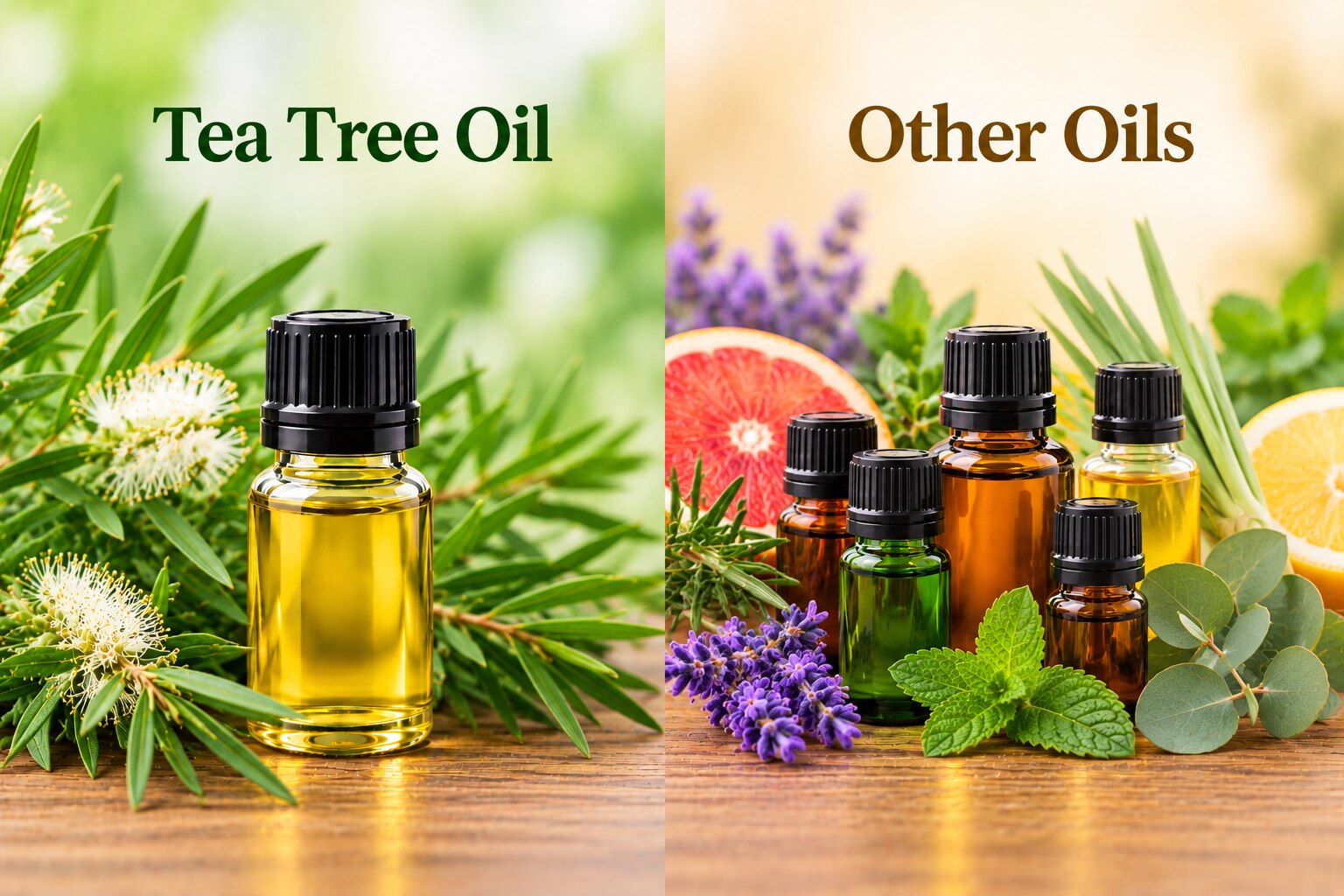
Choosing an essential oil by name or price alone can create problems with aroma, skin feel, oxidation, documentation, and finished-product claims. By comparing constituent profiles, product formats, safety controls, and supplier evidence, you can decide when tea tree oil fits your formula and when another oil is the better raw material.
Key takeaways
- Compare terpinen-4-ol, odour, colour, and oxidation—not price alone.
- Match each oil to the format, dosage, and consumer sensory experience.
- Require batch documents, storage controls, and defined “all grades” specifications.
- Release the lot only after claims, destination, and supplier checks pass.
How tea tree oil differs from turmeric, clove, eucalyptus, rosemary, peppermint, and aniseed oil
Compare marker chemistry, odour, colour, and oxidation behaviour—not price per kilogram. For tea tree oil compared with essential oils, terpinen-4-ol and terpene hydrocarbons define a sharp, medicinal, herbaceous profile; oxidation can increase sensitisation risk and alter consistency.
| Oil | Chemical markers | Sensory and formulation difference |
|---|---|---|
| Tea tree | Terpinen-4-ol, γ-terpinene | Fresh medicinal odour; pale colour; oxidation control matters |
| Turmeric | ar-Turmerone and other turmerones | Earthy, warm aroma; yellow-orange colour can stain clear products |
| Clove | Eugenol | Powerful spicy-warm odour; higher sensitisation concern and strong taste |
| Eucalyptus | 1,8-Cineole | Camphoraceous, cooling vapour; not interchangeable with tea tree |
| Rosemary | 1,8-Cineole, camphor, α-pinene | Woody, penetrating aroma; composition varies by chemotype |
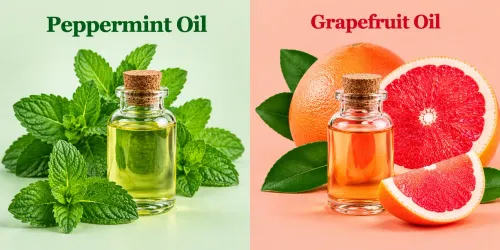
| Peppermint | Menthol and menthone | Distinct cooling sensation; intense aroma can dominate blends |
| Aniseed | trans-Anethole | Sweet liquorice odour; strong flavour and a different allergen profile |
For tea tree oil for manufacture comparison in Ahmedabad, check whether the intended format needs a clear, pale oil or accepts turmeric’s colour, and whether consumers expect cooling, warming, sweet, or medicinal notes. A scalp shampoo may tolerate tea tree’s profile; a facial serum can require tighter odour and oxidation control.
Keep the raw-material comparison separate from claims: antimicrobial or therapeutic wording changes the evidence and compliance review.
Match the oil to the product format and the consumer experience
Tea tree oil for wellness brands fits products seeking a sharp, medicinal-clean aroma, but the format determines whether that profile feels refreshing or harsh. Match the oil to the consumer’s expected sensory effect, not to an “antimicrobial” label; laboratory activity does not prove finished-product performance.
| Format | Stronger oil choices | Consumer experience and formulation point |
|---|---|---|
| Facial serums | Tea tree, rosemary | Use a restrained aroma; tea tree can feel medicinal, while rosemary is greener. Test irritation and oxidation. |
| Scalp products | Tea tree, rosemary, peppermint | Tea tree suits a clean scalp story; peppermint adds cooling. Neither proves a treatment claim. |
| Soaps | Tea tree, eucalyptus, clove | Wash-off formats tolerate bolder odours, but clove brings warmth and colour. |
| Balms | Eucalyptus, peppermint, tea tree | Eucalyptus feels penetrating; peppermint feels cool. Check inhalation and skin exposure. |
| Massage blends | Turmeric, rosemary, tea tree | Turmeric supports a warm, earthy profile; tea tree suits a fresher blend. |
| Shampoos | Tea tree, rosemary, peppermint | Balance rinse-off freshness against menthol intensity and scalp sensitivity. |
| Diffusers | Eucalyptus, peppermint, aniseed | Choose cineole freshness, menthol coolness, or sweet licorice character; assess room exposure. |
| Household wellness products | Tea tree, eucalyptus, clove | Strong aromas suit cleaners or sprays, but avoid implying disinfection without finished-product testing. |
Keep rinse-off, leave-on, ambient-air, and household uses separate when setting use levels, packaging, and claims. Never ingest essential oils, and protect children and pets from concentrated products.
Set safe use levels, exposure controls, and formulation checks
Set the maximum concentration for the finished product, not from the raw-material name. Use the applicable IFRA product category and exposure pattern—rinse-off, leave-on, oral, ambient-air, or household—and document the safety assessment. Undiluted tea tree oil can irritate skin and trigger allergic contact dermatitis; ingestion can be toxic.
- Require a use-level calculation, allergen review, and repeat-use assessment for leave-on products.
- Add a patch-test warning where the risk assessment supports it, and keep oil concentrates away from children.
- Prohibit oral use unless the product is specifically formulated, tested, packaged, and legally cleared for ingestion.
- Give diffuser users ventilation, time limits, and room-size instructions; never present inhalation as harmless.
- Keep concentrated oils away from pets, especially cats and small animals, and direct owners to veterinary advice after exposure.
- Treat “antimicrobial” as a claim requiring finished-product evidence: organism, concentration, contact time, formulation, and test method must match the marketed use.
Check compatibility before scale-up. Tea tree oil can oxidise, changing odour and sensitisation risk, so use an oxygen-limiting pack, suitable closure, light protection, and a defined storage temperature. Run stability, colour, odour, viscosity, preservative, and container-compatibility checks in the final formula.
Tea tree oil for wellness brands belongs in a controlled specification, not a generic “natural” allowance.
Define what “all grades” means before approving a tea tree oil lot
“All grades” must mean every lot meets the same approved specification, not that a supplier has a higher-sounding label. Define the material as steam-distilled Melaleuca alternifolia leaf oil for your intended topical format, with country of origin and extraction method recorded.
Tea tree oil manufacture in Ahmedabad may involve imported botanical oil followed by blending, standardisation, filling, or packing, so verify where cultivation and processing occurred.
1. Identity: Request the botanical name, plant part, extraction method, origin, organoleptic description, and batch-specific certificate of analysis. Ask whether the supplier claims conformity to ISO 4730.
2. Composition: Require a batch GC-FID or GC-MS chromatogram and marker ranges, including terpinen-4-ol and 1,8-cineole. Compare the result with the approved specification, not only a pass statement.
3. Purity: Request relative density or refractive index, allergen declaration, SDS, and contaminant results suited to topical use. “Pure” and “therapeutic grade” are marketing terms without these records.
4. Traceability: Record the batch number, production date, source, filling date, packaging, storage conditions, and retained-sample process. Confirm tamper evidence and oxidation controls.
GC similarity alone cannot exclude every adulterant. Use chiral profiling or targeted contaminant testing when supplier history, price, or formulation risk warrants it, and approve the finished product’s claim and exposure category separately.
Compare Ahmedabad supply offers by storage risk, continuity, and delivered cost
A bulk tea tree oil supplier in Ahmedabad should be judged on oxidation control and delivery reliability, not the kilogram quote alone. Compare the delivered cost after freight, filling losses, testing, rejected lots, and reformulation caused by odour or marker variation.
| Offer dimension | What to compare | Cost or failure exposed |
|---|---|---|
| Processing | Steam-distilled origin versus local blending or standardisation; botanical name, country, batch traceability, and GC-FID or GC-MS records | Identity and composition risk |
| Packaging and storage | Full aluminium or compatible lined containers, light protection, headspace, seal integrity, manufacturing date, retest date, and storage below heat and sunlight | Oxidised oil, leakage, and dermatitis risk |
| Sampling | A sealed pre-shipment sample linked to the proposed batch, plus retained-sample policy | Paying for a lot you have not approved |
| Continuity | Lead time, safety stock, seasonal sourcing, MOQ, and replacement-batch consistency | Production stoppage or forced substitution |
| Quotation | Delivered Ahmedabad price, freight, GST, testing, packing, credit terms, and validity period | A misleading low ex-warehouse price |
For tea tree oil manufacture in Ahmedabad, ask SHANTI AROMATICS or any competing supplier to document these points in one quotation. Reject offers that provide only “pure” or “therapeutic grade” without a specification, SDS, allergen declaration, and storage instructions.
Related products
 | ESSENTIAL OIL ₹1800 All grade View product → |
 | ESSENTIAL OIL ₹1800 100% natural View product → |
Use a release checklist for claims, market destination, and final supplier selection
Convert the comparison into a signed release record covering the market destination, raw-material acceptance, and finished-product approval. Fix the intended claim and exposure route before purchase; a fragrance ingredient, cosmetic, and antimicrobial or therapeutic product require different evidence.
1. State the destination, product format, rinse-off or leave-on route, consumer group, and proposed claim. Check the applicable IFRA category and prohibit ingestion claims unless the finished product has a separate safety and regulatory basis.
2. Attach the purchase specification: botanical identity, odour and appearance, density or refractive index, GC-FID or GC-MS profile, ISO 4730 conformity where claimed, batch traceability, SDS, allergen declaration, contaminants, manufacturing date, retest date, packaging, and storage conditions.
3. Compare suppliers on delivered cost, oxidation controls, sample results, lead time, minimum order, and replacement terms. Reject “pure” or “therapeutic grade” without supporting records.
4. Approve a pilot and finished batch against use level, irritation assessment, child-exposure controls, label wording, stability, odour, and packaging compatibility.
Use the tea tree oil for manufacture comparison in Ahmedabad as the decision file, not a price sheet. Select a bulk tea tree oil supplier in Ahmedabad only after procurement, quality, and regulatory sign-off.
Frequently asked questions
How does tea tree oil compare with turmeric, clove, eucalyptus, rosemary, peppermint, and aniseed oil?
Compare marker chemistry, odour, colour, and oxidation behaviour. Tea tree oil is associated with terpinen-4-ol and terpene hydrocarbons, while each comparison oil creates a different sensory profile and formulation trade-off.
How should you match tea tree oil to a wellness product format?
Choose the oil after defining the product format, intended skin or inhalation exposure, dosage, odour target, colour tolerance, and the consumer experience you want to create.
What checks belong in a tea tree oil safety and formulation review?
Set a use level, define exposure controls, review oxidation risk, and test compatibility, odour, colour, and stability in the finished formula before release.
What does “all grades” mean when approving a tea tree oil lot?
Define the phrase in measurable terms, including the intended application, marker chemistry range, appearance, odour, test documents, batch traceability, packaging, and storage conditions.
How should Ahmedabad buyers compare bulk tea tree oil suppliers?
Compare storage risk, continuity of supply, documentation, lead time, packaging, minimum order terms, and delivered cost rather than price per kilogram alone.
Related products
 | ESSENTIAL OIL ₹1400 Best quality of clove oil manufacturers View product → |
 | ESSENTIAL OIL ₹1200 We are manufactured of eucalyptus oil IP /Bp MOQ : 25 kg View product → |
 | Oils ₹1500 CERTIFICATE OF ANALYSIS OF ROSEMARY OIL Product : Rosemary oil Origin : Indian. Colour : yellow colored, clear liquid. View product → |
 | ESSENTIAL OIL ₹1100 We are manufactured of aniseed oil . View product → |