Peppermint oil and grapefruit oil solve different formulation problems: one brings menthol-led cooling and persistence, while the other delivers a bright citrus effect with greater oxidation and, for some expressed oils, phototoxicity considerations. By comparing sensory performance, regulatory route, batch evidence, storage controls, and Ahmedabad procurement terms, you can select the oil that fits the finished product rather than relying on “natural” or “export grade” as proof of suitability.
Key takeaways
- Choose peppermint for cooling impact; choose grapefruit for citrus lift.
- Confirm the product’s regulatory route before approving either oil.
- Request identity, chemistry, batch, allergen, and safety documents.
- Sample from multiple containers and control oxidation before release.
Choose by sensory performance, not by the word “fresh”
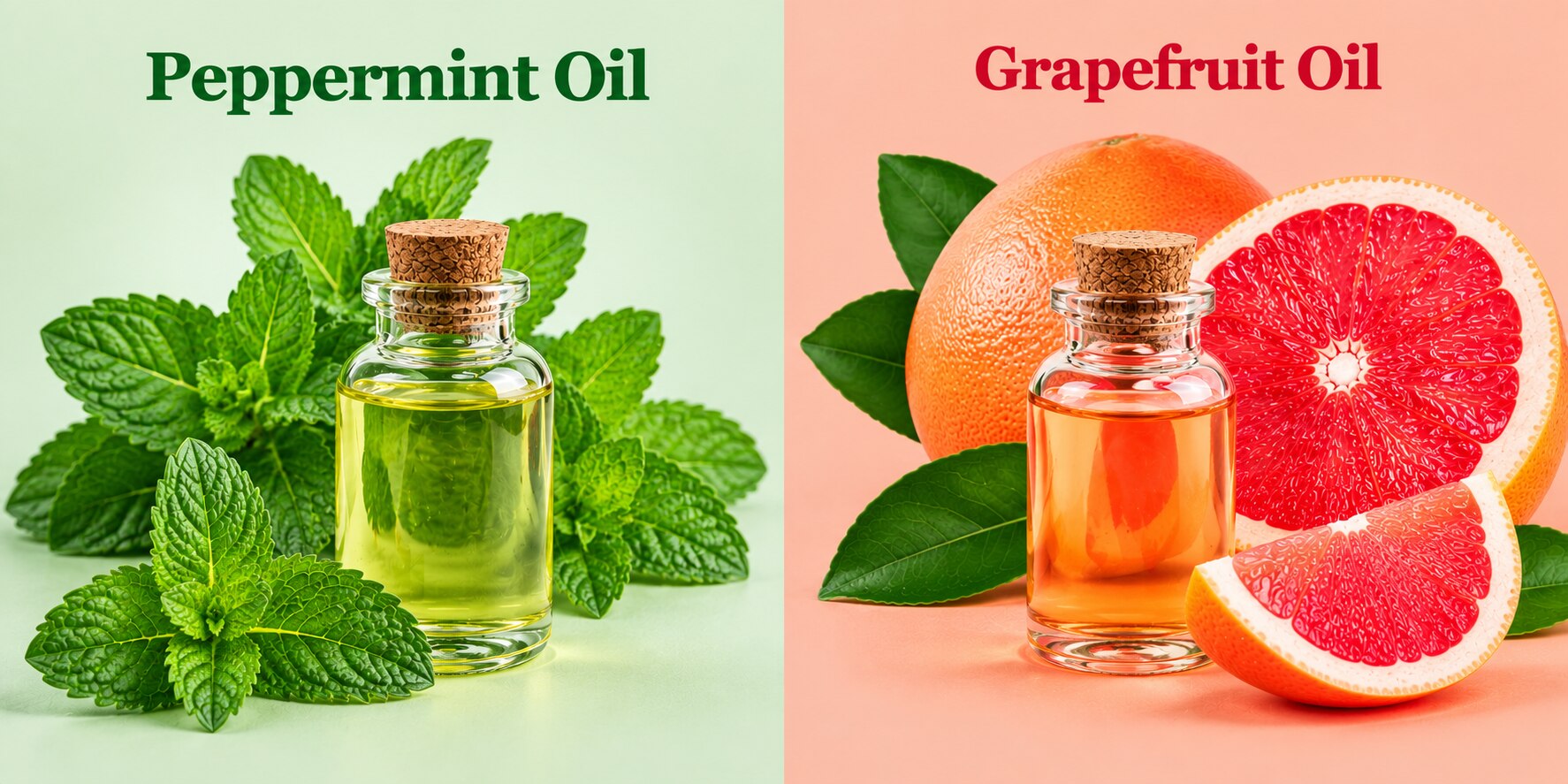
Peppermint oil versus grapefruit oil is a choice between cooling impact and citrus lift, not between two interchangeable versions of “fresh.” Peppermint delivers a strong mint character linked to menthol and menthone; menthol-rich material can create noticeable cooling at low dosage and leave a more persistent sensory signature.
Grapefruit oil is brighter and sharper, led by limonene and other peel volatiles, so its top note usually rises quickly and fades sooner.
| Option | Sensory behaviour | Formulation consequence |
|---|---|---|
| Peppermint oil | Cool, minty, penetrating, with strong impact at low dosage | Fits oral care, cooling personal care, selected cleaners, and mint fragrance profiles; excessive use can dominate or irritate |
| Expressed grapefruit oil | Bright, juicy citrus with limonene and nonvolatile peel constituents | Suits citrus fragrance, personal care, cleaners, and flavour routes; oxidation can flatten the odour and shift colour |
| Distilled grapefruit oil | Cleaner, lighter citrus profile with fewer heavy peel constituents | Useful when colour, residue, or a less rounded citrus note matters; confirm that its aroma matches the target |
Choose grapefruit when consumers expect sparkling citrus or when menthol would conflict with the product experience. Choose peppermint when cooling, mint persistence, or oral-care recognition matters; it is the wrong choice for a soft floral profile or a product where irritation risk is unacceptable.
For grapefruit oil manufacture in Ahmedabad, confirm whether the material is mechanically expressed or steam-distilled. The city address does not prove local manufacture: request the extraction site, botanical identity, and batch certificate before comparing quotations.
Match the oil to the product and regulatory route
Peppermint fits products that need a strong cooling, minty signal; grapefruit fits products that need a bright citrus lift without menthol. They are not interchangeable: peppermint oil for industrial products can alter irritation, sensitisation, flavour, and exposure assessments at low dosage, while grapefruit oil can introduce oxidation and phototoxicity questions.
| Option | Best-fit applications | Regulatory and formulation route |
|---|---|---|
| Peppermint oil | Toothpaste, mouthwash, chewing gum, mint flavour, personal-care products, household cleaners, and mint fragrance | Specify Mentha × piperita aerial herb oil, usually steam-distilled; assess menthol and menthone, intended exposure, allergen declaration, residual solvents, and flavour or fragrance status |
| Grapefruit oil | Citrus fragrances, shampoos, soaps, cleaners, beverages, confectionery, and products where a fresh peel character matters | Specify expressed or distilled peel oil; confirm limonene profile, colour, oxidation stability, flavour or fragrance route, and phototoxicity data for leave-on products |
| Neither by default | Products where colour, odour persistence, irritation, or consumer expectation conflicts with the formula | Do not approve “industrial grade” alone; state the finished-product use and required documents |
Choose peppermint when menthol intensity supports the product and a cooling effect is desirable. Choose distilled grapefruit when you need citrus with reduced nonvolatile peel material; choose expressed grapefruit only after reviewing the exact batch’s IFRA certificate or furocoumarin analysis for sun-exposed leave-on products.
A peppermint specification should include menthyl acetate and menthofuran alongside menthol and menthone; a grapefruit specification should identify limonene and the extraction method.
Specify identity, chemistry, and documents before approving a batch
Approve a batch only after matching its identity, chemistry, and batch records; an Ahmedabad address does not prove local manufacture. For peppermint oil for industrial products, request Mentha × piperita, aerial herb, and steam distillation. For grapefruit, request Citrus paradisi peel and expression or cold-pressing, plus the actual manufacturing site, origin, and batch number.
Claims of grapefruit oil manufacture in ahmedabad need this evidence.
| Record | Peppermint oil | Grapefruit oil |
|---|---|---|
| Botanical identity | Mentha × piperita, aerial herb | Citrus paradisi, peel |
| Identifiers | CAS and FEMA numbers stated | CAS and FEMA numbers stated |
| Markers | Menthol, menthone, menthyl acetate, menthofuran | Limonene and other peel volatiles |
| Physical data | Refractive index, specific gravity, optical rotation, residue on evaporation | Refractive index, specific gravity, optical rotation, residue on evaporation |
| Profile | Batch GC chromatogram with marker ranges | Batch GC chromatogram with marker ranges |
Require a batch-specific certificate of analysis, SDS, allergen declaration, residual-solvent statement, manufacturing or repacking record, and traceability from source to drum. Compare results against one agreed specification and test method; a pass from two different methods is not a reliable comparison.
Before sampling peppermint, document storage temperature, mixing or homogenisation, and top-middle-bottom sampling. Menthol-rich oil can crystallise, leaving a top sample unlike the drum average. Reject unexplained changes in marker ratios, physical constants, colour, or residue until the supplier explains them with retained-sample results.
Control oxidation, crystallisation, and representative sampling
A visible crystal in peppermint oil does not prove contamination: menthol-rich material can crystallise after cooling or repeated temperature changes. Grapefruit oil is more vulnerable to oxidation, which can shift its fresh peel odour, darken its colour, and alter assay results.
Store both oils in tightly closed, light-protective containers with minimal headspace, and avoid heat and temperature cycling.
Before opening, record the seal, drum condition, storage temperature, appearance, colour, and odour. For peppermint oil, define a validated homogenisation step before sampling; do not take only the clear top layer while crystals remain. Do not heat a drum without checking that the method will not strip volatile components.
- Confirm the batch number, manufacturing date, actual manufacturing site, extraction method, and batch-specific certificate of analysis.
- Homogenise the full container using the approved procedure, then collect samples from top, middle, and bottom when the batch is nonuniform.
- Compare density or relative density, refractive index, optical rotation where applicable, organoleptic description, and GC-FID or GC-MS profile against the specification.
- Investigate oxidation with colour, odour, peroxide or other agreed stability tests; investigate peppermint crystallisation with temperature history and menthol-related profile data.
- Quarantine the batch if samples disagree, the seal is damaged, or assay falls outside limits; do not blend it away before root-cause review.
For peppermint oil versus grapefruit oil, retain an original sample and a correctly homogenised composite sample. A supplier’s local stock location does not establish Ahmedabad manufacture; traceability must follow the batch.
Compare Ahmedabad suppliers on delivered performance and risk
A bulk peppermint oil supplier in ahmedabad earns a commercial order by proving delivered performance, not by quoting the lowest drum price. Compare the complete offer against your specification and finished-product risk.
| Measure | Peppermint oil | Grapefruit oil |
|---|---|---|
| Delivered cost | Price per kilogram, freight, taxes, and handling included | Same basis; separate expressed and distilled grades |
| Identity | Mentha piperita, leaf or flowering top, extraction method, origin, menthol and menthone profile | Citrus paradisi peel, expression or steam distillation, limonene and oxygenated-terpene profile |
| Physical data | Density, refractive index, optical rotation, colour, odour, GC-FID or GC-MS | The same data, plus furocoumarin information for expressed oil |
| Commercial risk | MOQ, drum size, lead time, shelf-life or retest date, and out-of-specification replacement terms | Those terms plus phototoxicity documentation for leave-on products |
Before placing the order, ask the seller for:
- A batch-specific certificate of analysis showing the batch number, botanical name, plant part, extraction route, key markers, physical constants, and microbiological or contaminant results required for your end use.
- Written confirmation that the quotation covers pure oil, not a standardized, rectified, diluted, or blended preparation.
- The actual manufacturing site, because an Ahmedabad address may represent a distiller, importer, blender, or repacker.
- A replacement or credit procedure for failed assay, odour, colour, contamination, or identity results.
For grapefruit oil manufacture in ahmedabad, SHANTI AROMATICS should be compared using the same batch evidence, rather than its location or catalogue wording. An expressed grade without applicable IFRA or analytical furocoumarin data is an avoidable risk in sunlight-exposed products.
Related product
 | ESSENTIAL OIL ₹1800 100% natural And export grade View product → |
Frequently asked questions
When should you choose peppermint oil over grapefruit oil?
Choose peppermint oil when cooling impact, mint character, menthol, menthone, and a persistent sensory signature support the formulation. Choose grapefruit oil when a citrus lift fits the product better.
What should Ahmedabad industrial buyers verify before approving a batch?
Request the botanical identity, extraction or production details, chemistry profile, batch number, certificate of analysis, safety data sheet, allergen information, and documents required for the product’s regulatory route.
How should you control oxidation and crystallisation?
Use suitable storage conditions, protect the oil from heat, light, air, and moisture, and check the container for changes in colour, odour, clarity, and sediment. Review crystallisation risk where menthol-rich peppermint oil is used.
How can you compare peppermint and grapefruit oil suppliers in Ahmedabad?
Compare delivered sensory performance, batch consistency, documentation quality, packaging, storage controls, sampling practice, lead time, and the supplier’s response when a batch fails specification.