Choosing between distilled lemongrass oil, isolated citral, another essential oil, or a fixed industrial oil depends on chemistry, process, stability, and end use—not price per kilogram alone. You will be able to compare manufacturing routes, read the specifications and certificate of analysis, assess supply risks, and select the material that fits your formulation.
Key takeaways
- Compare citral content, aroma, stability, and application fit before selecting an oil.
- Ask for batch-specific GC analysis, density, refractive index, and optical rotation.
- Store lemongrass oil sealed, cool, dark, and protected from oxygen and moisture.
- Verify the Ahmedabad supplier’s botanical source, traceability, testing, and export documents.
How the Manufacturing Route Changes the Oil You Receive
Commercial lemongrass oil manufacture normally uses steam distillation of cut Cymbopogon flexuosus or Cymbopogon citratus leaves. Operators may wilt or partially dry the leaves to reduce excess water, but excessive drying can lower volatile recovery and change the aroma.
| Route | Recovery, heat and water contact | Oil received and documentation |
|---|---|---|
| Steam distillation | Steam strips volatile oil without immersing the leaves; longer exposure raises energy use and oxidation or hydrolysis risk | Distillate-like colour and aroma; track yield, geranial, neral, colour, odour and energy consumption |
| Hydrodistillation | Leaves contact boiling water directly, increasing water exposure and prolonged heating | Can increase hydrolysis, darker colour or cooked notes; useful for small-scale comparison, less attractive for consistent bulk production |
| Solvent extraction | Solvent can recover less-volatile material that steam leaves behind, with different recovery and lower distillate character | Fuller or heavier aroma and colour; requires solvent identity, residual-solvent limits and removal records |
| Isolated citral | Avoids plant extraction and gives controlled geranial-plus-neral marker content | More predictable marker dosing, but no complete natural oil profile; odour, natural-origin claims and traceability change |
Higher yield is not automatically better. Severe or extended distillation can recover more residual oil while degrading citral and consuming more energy. Compare all six measures together before changing still time, wilting or steam rate.
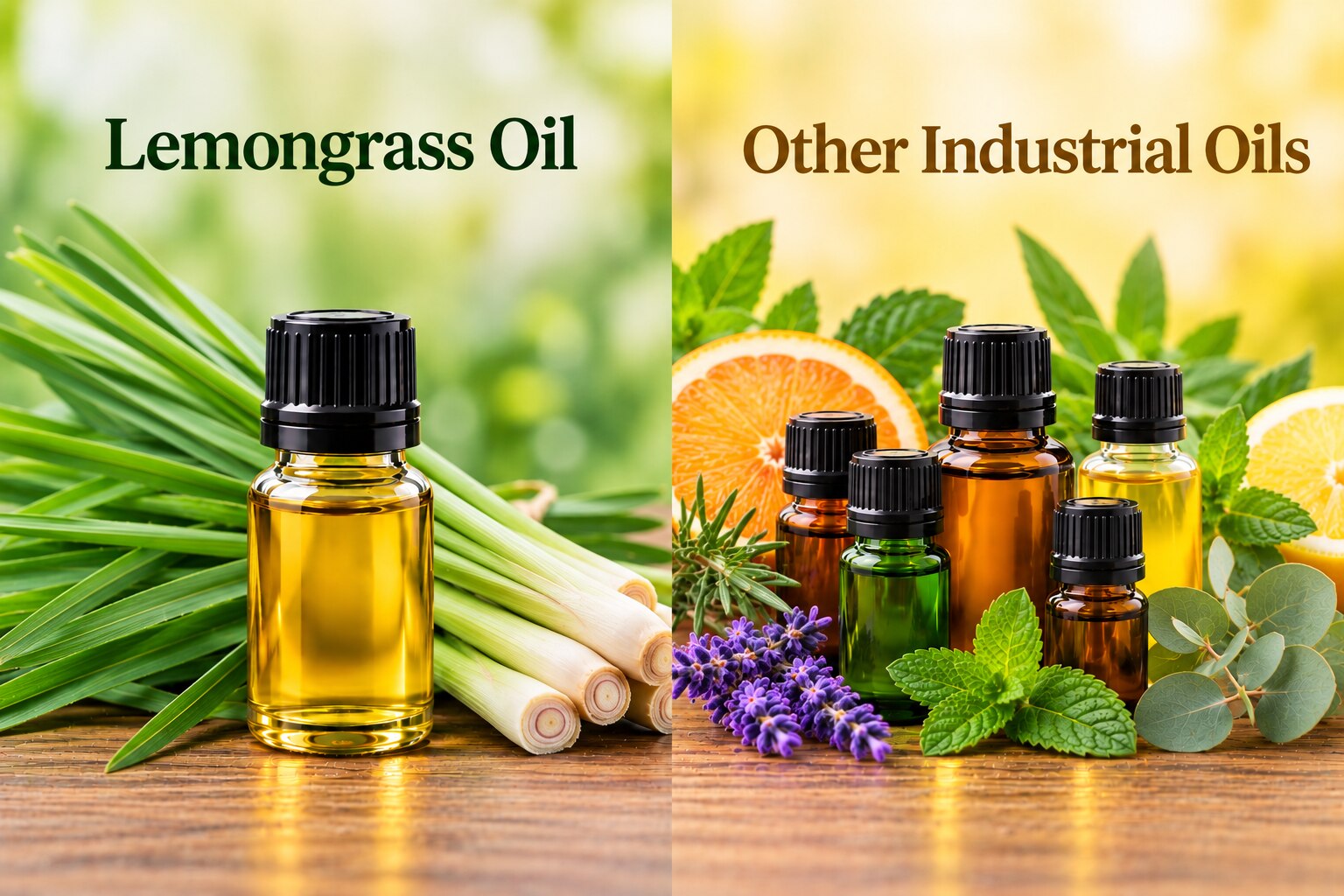
When Lemongrass Oil Beats Lemon, Rosemary, Clove, or Fixed Industrial Oils
Choose lemongrass oil when the formulation needs a volatile, citral-led fresh lemon-grass odour rather than lubrication, a heavy carrier, or a different botanical signature. Compare function, oxidation, handling and finished-product dosage—not only purchase price.
| Option | Chemical and odour profile | Best fit and cautions |
|---|---|---|
| Lemongrass oil | Geranial- and neral-rich; fresh, sharp, lemon-grass aroma | Volatile fragrance ingredient. Protect from heat, light and oxygen; check oxidation, dispersibility and residue. |
| Lemon oil | Citrus terpenes and peel-derived aldehydes; brighter peel character | Citrus fragrance where peel notes fit. Cold-pressed grades can bring waxes, pigments, nonvolatile residue and pesticide concerns. |
| Rosemary oil | Herbal, camphoraceous profile | Herbal fragrance or functional aroma; it will not reproduce citral’s freshness. |
| Clove oil | Eugenol-led, powerful spicy odour | Strong odour systems, but assess staining, material compatibility and residue. |
| Canola, soybean, sunflower, castor and palm oils | Fixed triglyceride oils | Lubrication, coatings, oleochemical conversion or carrier functions; not substitutes for volatile aroma ingredients. |
Lemongrass oil can oxidise, darken and lose odour quality during poor storage. Compare cost at the required citral or active-marker level and finished-product dosage: a cheaper kilogram can cost more after higher dosing, poor dispersibility, residue, or compatibility failures. Bulk industrial oils belong in a separate performance comparison.
Which Lemongrass Oil Specifications Actually Control Performance?
A usable lemongrass oil specification makes geranial and neral, the two main citral isomers, the central purchasing control. Total citral often falls roughly within 65–85% for commercial material, but state the Cymbopogon species, applicable standard, and test method before accepting that range.
Include these fields:
- Botanical name, plant part, country or region of origin, appearance, and odour
- Relative density or specific gravity, refractive index, optical rotation, acid value, and flash point
- Water or moisture content, plus residue limits where the intended application requires them
- Solubility or dispersibility guidance for the formulation system
- A GC-FID or GC-MS profile covering geranial, neral, geraniol, geranyl acetate, limonene, myrcene, and other expected constituents
A total-citral result from GC-FID area percentage is not interchangeable with GC-MS interpretation or a titrimetric result. Put the method, calculation basis, and reporting units on the purchase specification.
| Control | What it can show | What it cannot prove alone |
|---|---|---|
| Density and refractive index | A physical consistency check | Genuine identity or absence of dilution |
| Geranial and neral by GC | Citral level and isomer balance | Complete authenticity without the wider chromatogram |
| Full GC profile | Terpene pattern, blending, and unusual additions | Compliance with application-specific safety requirements |
Density and refractive index alone can miss dilution with terpenes, another essential oil, or isolated citral. Pair them with the chromatogram, traceability, and intended-use limits.
How to Read a Batch COA and Investigate Variation Before Release
Release the lot only when every COA field matches the purchase specification, not when total citral looks acceptable.
- Match the supplier and product name to the purchase order.
- Confirm botanical identity, plant part, origin, batch number, manufacture date, and retest or expiry date.
- Check each test method: GC-FID, GC-MS, Karl Fischer, refractive index, optical rotation, acid value, or another named procedure.
- Compare every specification limit with its result, including density, moisture, residue, colour, and odour.
- Require the analyst’s approval signature, date, and laboratory identification.
Review the chromatogram, not just the reported citral total. Locate and compare the relative positions and areas of geranial, neral, geraniol, geranyl acetate, limonene, myrcene, and other expected constituents. Investigate citral below range, an unusual geranial-to-neral balance, changed optical rotation, unexpected colour or sediment, high acid value, water, residue, or a missing method.
Trace variation to Cymbopogon species or cultivar, harvest age, wilting, leaf-to-stem material, distillation heat and duration, storage time, or post-production blending. Ask a lemongrass oil industrial supplier for retained samples, batch traceability, distillation records, an SDS, allergen declarations, and application-specific regulatory statements. Hold the lot until those records and a comparison sample explain the deviation.
How to Receive, Store, and Formulate Lemongrass Oil Without Losing Its Profile
Protect lemongrass oil in a compatible, tightly closed container with minimal headspace. Keep it away from direct light and heat, limit repeated opening and oxygen exposure, and maintain the storage temperature specified by the supplier.
At receiving, inspect the seal, container, closure, and oil before release:
- Photograph any broken seal, leakage, dented closure, sediment, cloudiness, or unexpected darkening.
- Quarantine the lot and record its batch number.
- Request a retained-sample review or replacement review before using the material.
Pre-dilute the oil into a compatible carrier when you need controlled dosing. Add it gradually to oil-based systems; pre-disperse or solubilize it before adding it to water-based systems.
Run a small compatibility test before production. Check for separation, haze, colour shift, odour carryover, and packaging attack. Set dosage for the finished product and its regulatory category, not as a universal percentage copied from another formulation. Clean transfer lines, pumps, and vessels between batches to prevent fragrance carryover.
What to Verify Before Choosing an Ahmedabad-Based Industrial Supplier
Before placing a bulk order, verify that a lemongrass oil manufacturer in Ahmedabad actually manufactures the material. A trading address proves distribution, not distillation.
Request this evidence:
- Botanical source and species, process description, origin, harvest information, agreed citral range, and a recent lot-specific COA with GC chromatogram.
- Batch traceability, retained-sample policy, packaging details, storage conditions, and evidence of suitable storage capacity.
- SDS, allergen statement, and an application-specific regulatory declaration for fragrance, cleaning, cosmetic, flavour, or technical use.
Evaluate SHANTI AROMATICS against this same checklist; its name alone cannot replace technical due diligence.
| Option | Choose it when | Main control |
|---|---|---|
| Distilled lemongrass oil | Complete natural citral profile and aroma matter | Species, lot GC, odour |
| Isolated citral | A defined single-marker function is required | Purity and dosage |
| Fixed or non-natural industrial oil | Lubrication, carrier performance, or oleochemical processing is the job | Viscosity and process fit |
Related product
 | Natural oil ₹1200 Shanti aromatics in manufacture in lemongrass oil MOQ. 25 kg View product → |
Frequently asked questions
How does lemongrass oil manufacture affect the oil you receive?
Steam distillation of Cymbopogon leaves produces an oil whose aroma and yield depend on species, leaf condition, distillation control, and storage after production.
Which lemongrass oil specifications control industrial performance?
Review citral content, density, refractive index, optical rotation, appearance, odour, solubility, and batch-specific GC data against your formulation requirements.
How should you read a lemongrass oil batch COA?
Match the COA to the batch number, check test methods and limits, compare citral and physical values with prior lots, and investigate unexplained changes before release.
How should you store and formulate lemongrass oil?
Keep it in tightly sealed, compatible containers away from heat, light, air, and moisture; add it during a formulation step that limits unnecessary oxidation and evaporation.