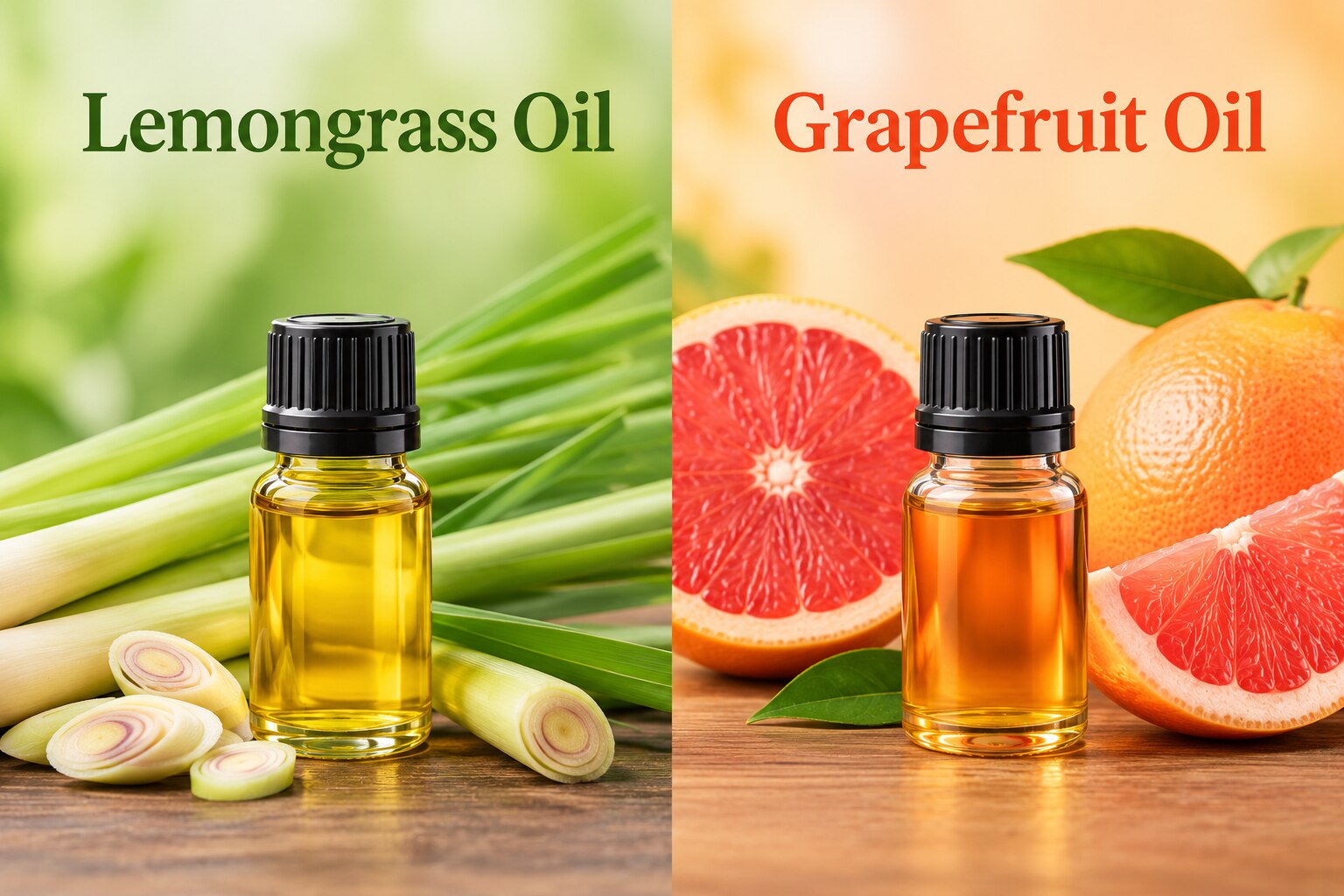
Choose between these oils by matching their aroma strength, chemical profile, extraction method and safety evidence to the finished product. By the end, you will be able to select a starting material, run a controlled bench trial, request the right documents and avoid reformulation caused by oxidation, phototoxicity or inconsistent batches.
Key takeaways
- Choose lemongrass for sharp herbal citrus and grapefruit for lighter fresh brightness.
- Compare steam-distilled lemongrass with the grapefruit fraction matched to your fragrance brief.
- Set a small bench trial before approving production dosage or scaling the formula.
- Check batch number, COA, GC-MS results, storage conditions and consistency before purchase.
Match each oil to the cosmetic product and fragrance brief
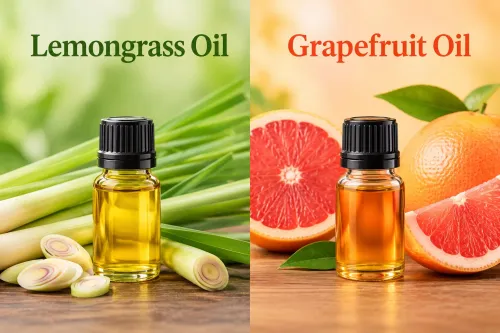
Lemongrass oil is the better choice when a formula needs a strong, sharp herbal-lemon identity; grapefruit oil suits a lighter, fresher citrus brief. For lemongrass oil for cosmetics, the citral profile comes from neral and geranial, while grapefruit oil is largely limonene-led.
| Product or brief | Better functional choice | Reason |
|---|---|---|
| Cleansers | Grapefruit oil | Fresh brightness without a dominant grassy note |
| Soaps and shampoos | Lemongrass oil | Strong herbal-lemon character survives the base |
| Body washes | Lemongrass oil | Clear citrus impact in a rinse-off product |
| Lighter body products | Grapefruit oil | Fresher, less forceful citrus impression |
| Creams | Grapefruit oil | Brightness is less likely to overwhelm the cream |
| Strong citrus accords | Lemongrass oil | Citral gives the fragrance a recognisable lemon-grass signature |
| Fine fragrances | Grapefruit oil | A lighter top note leaves more room for the composition |
Lemongrass can dominate a cream or fine fragrance, so grapefruit is the better starting point when brightness matters more than a grassy-lemon signature. The choice in lemongrass oil versus grapefruit oil is not a universal substitution: changing the oil alters odour, allergen declaration, oxidation behaviour and fragrance balance.
Before comparing quotations or formulas, confirm that the material is grapefruit essential oil, not grapefruit seed extract, grapefruit fragrance oil or lemon oil. Those materials have different compositions, uses and safety assessments; a lower price does not make them interchangeable.
Compare steam-distilled lemongrass with the correct grapefruit fraction
Steam-distilled lemongrass and grapefruit oil are not equivalent citrus materials. Lemongrass normally comes from Cymbopogon flexuosus or Cymbopogon citratus leaves, and its value depends on citral, the combined neral and geranial content, not total oil yield. Request citral by GC-FID or GC-MS; “100% pure” proves little.
| Material | Usual source and process | Purchasing implication |
|---|---|---|
| Lemongrass oil | Leaves; steam distillation | Confirm species and citral profile |
| Expressed grapefruit oil | Peel; abrasion, water and centrifugal separation, or cold expression | Check colour, oxidation stability and furocoumarins |
| Distilled or rectified grapefruit fraction | Peel oil processed by distillation or rectification | Confirm what was removed and whether it remains genuine grapefruit oil |
Grapefruit oil commonly comes from peel. Require the supplier to state whether it is expressed, distilled, rectified or another fraction, because that choice changes colour, odour, stability and furocoumarin content.
Expressed grapefruit oil can contain phototoxic furocoumarins; a properly distilled or furocoumarin-controlled fraction has a different profile. Verify peel origin, fruit treatment, 5-MOP and total furocoumarin results, and reject a material described only as a limonene-rich citrus fraction.
For grapefruit oil manufacture in Ahmedabad, ask for those batch records before comparing prices. If your search is “grapefruit oil manufacture lemongrass oil for comparison in Ahmedabad,” confirm that both materials retain their stated botanical identity rather than comparing a natural oil with a terpene fraction.
Set a safe bench-trial level before scaling the formula
Start with three or four small batches, not an internet dilution presented as a final dosage. Record each oil as a percentage of the finished formula and calculate fragrance load as:
oil weight ÷ total batch weight × 100
| Oil | Compare in the bench trial | Main safety screen |
|---|---|---|
| Lemongrass oil | Strong citral-led odour; assess whether neral and geranial overpower the formula | Citral sensitisation and oxidation products |
| Grapefruit oil | Lighter, limonene-led freshness; assess brightness after storage | Limonene oxidation and furocoumarin phototoxicity |
- Keep the oil level different in each batch, such as a low, middle and high trial level permitted by the formulation brief; do not scale any level until the required safety review is complete.
- Compare odour after 24 hours and again after one, two and four weeks.
- At the planned storage temperature, check colour, pH, viscosity, separation and package compatibility.
- Test leave-on and rinse-off products separately. For leave-on products applied to sunlight-exposed areas, assess finished-product concentration, application area and exposure conditions.
For lemongrass oil for cosmetics, obtain a current allergen declaration because citral can sensitise skin and form more sensitising oxidation products. For grapefruit, screen limonene oxidation and phototoxicity, especially with expressed oil.
Request the supplier’s current IFRA conformity certificate for the exact material and intended product category. Use it with the applicable safety assessment, not as proof of purity. Before commercial release, review India’s Cosmetics Rules, 2020 and the destination market’s current requirements, with a qualified safety assessor reviewing the finished formula.
Use batch documents and test results to approve the oil
A persuasive product description proves identity; a suitable cosmetic raw material proves batch consistency, safety, and composition. Ask for these documents and identifiers before approving a bulk lemongrass oil supplier in Ahmedabad or reviewing grapefruit oil manufacture in Ahmedabad:
- Current certificate of analysis, SDS, IFRA conformity certificate, allergen declaration, botanical name, plant part, country and region of origin, extraction method, batch number, production date, retest or expiry date, and storage conditions.
- Appearance, colour, odour, specific gravity, refractive index, optical rotation where applicable, peroxide value or another oxidation-status measure, residue on evaporation, and a GC-MS or GC-FID profile.
- Citral results for lemongrass; limonene and aldehyde results for grapefruit; and furocoumarin or 5-MOP results when relevant.
| Evidence | Lemongrass oil | Grapefruit oil |
|---|---|---|
| Identity risk | Steam-distilled oil can be extended with isolated citral | Oil can be diluted with cheaper limonene-rich fractions |
| Useful confirmation | Citral ratio plus marker compounds | Limonene, aldehydes, peel markers and furocoumarins |
| Higher-value purchase | Add isotope-ratio, chiral or other orthogonal testing | Add isotope-ratio, chiral or other orthogonal testing |
GC-MS alone can miss economical substitution. Retain a sealed sample, then compare repeat batches against agreed chromatographic and sensory limits. Define those limits before purchase, not after a batch fails.
Store the oil in compatible, light-protective containers with limited headspace, cool conditions, and documented resealing after sampling. A missing batch record, unexplained chromatogram, or failed oxidation result is a reason to pause approval.
Make the sourcing decision around consistency, storage and total reformulation cost
Approve neither oil for bulk purchase until the sample passes formula stability, packaging compatibility, sensory testing and document review.
Use this approval checklist:
- Confirm lead time, minimum order quantity, sample-to-bulk continuity and repeat-batch specifications.
- Require a written change-notification process covering origin, extraction, processing aids, packaging and specifications.
- Ask whether Ahmedabad stock is locally manufactured or imported material warehoused locally. An evaluation of grapefruit oil manufacture in Ahmedabad must include batch-level peel origin and manufacturing records.
- Request a current certificate of analysis, SDS, IFRA conformity certificate, allergen declaration and batch-specific GC-FID or GC-MS results.
| Decision point | Lemongrass oil | Grapefruit oil |
|---|---|---|
| Consistency check | Compare citral, neral and geranial limits | Compare limonene, aldehydes and furocoumarin results |
| Storage risk | Oxidation can alter odour and sensitisation profile | Limonene oxidation can create sensitising products |
| Packaging | Use compatible lined, light-protective containers | Use the same, with oxidation-status or peroxide-value controls |
Require well-closed containers, limited headspace, cool storage away from heat and sunlight, and documented resealing after every sample withdrawal. A bulk lemongrass oil supplier in Ahmedabad, including Shanti Aromatics, should provide this evidence for both oils.
Choosing on aroma alone can make a failed oxidation, sensory or stability test consume pilot batches, packaging, laboratory time and launch capacity. Select the oil that meets agreed sensory, safety and repeat-batch limits, not merely the lowest price or shortest location-based lead time.
Related product
 | Lemongrass oil ₹1100 CERTIFICATE OF ANALYSIS OF LEMONGRASS OIL Product : Lemongrass oil Colour : Pale yellow to orange brown liquid . View product → |
Frequently asked questions
Which oil suits a sharp herbal-lemon cosmetic fragrance?
Choose steam-distilled lemongrass when the brief needs a strong, sharp herbal-lemon identity driven by neral and geranial.
When is grapefruit oil the better choice?
Choose grapefruit oil for a lighter, fresher citrus profile, then confirm that the selected fraction matches the intended fragrance and cosmetic application.
How should you compare lemongrass and grapefruit oil before scaling?
Run controlled bench trials at a defined starting level, compare odour, colour and formula performance, then scale only after the preferred level is confirmed.
Which documents should approve a cosmetic oil batch?
Request the batch number, certificate of analysis, GC-MS test results, specification sheet and storage information, and compare them with your approved sample.