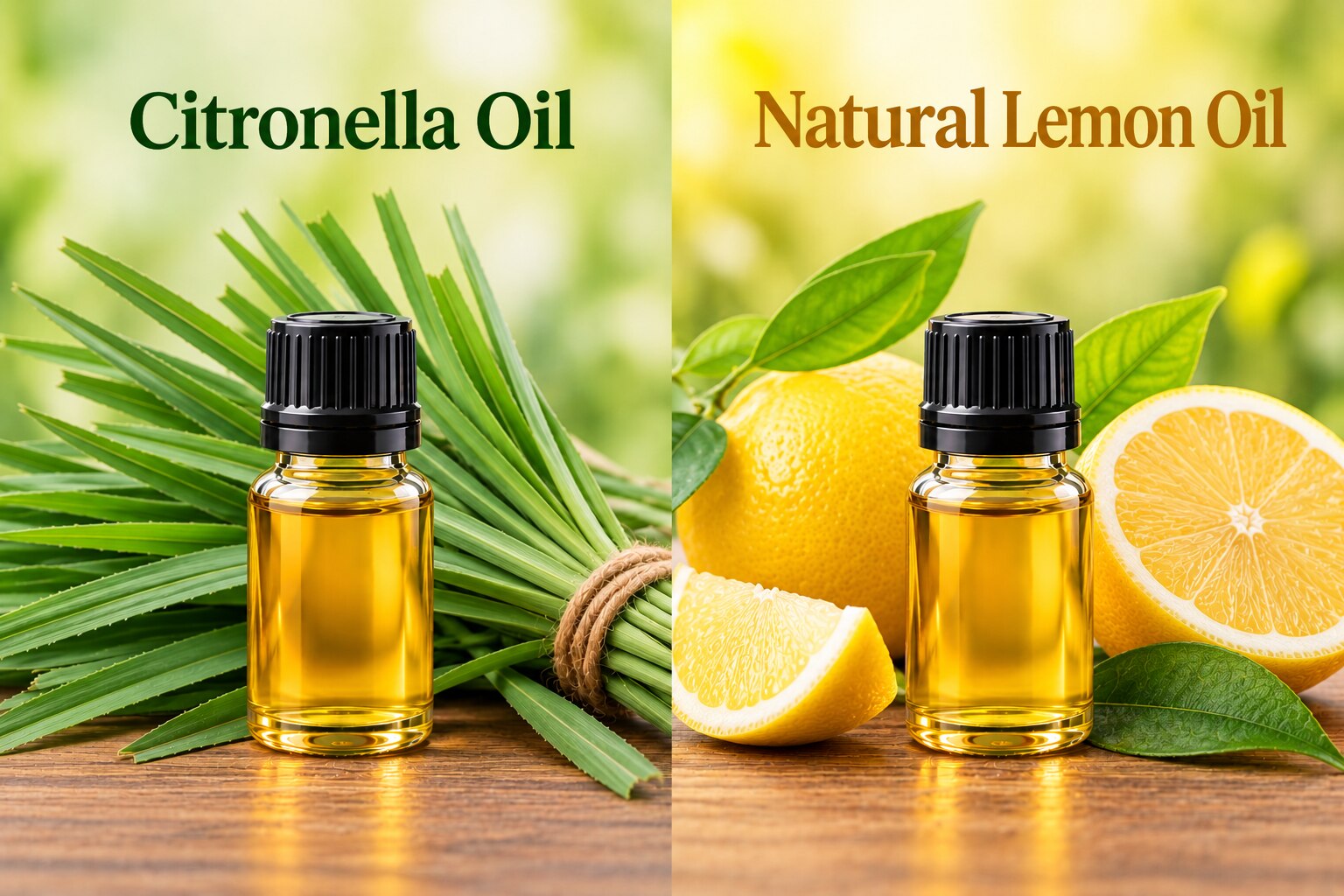
Lemon oil and citronella oil can both add natural fragrance, but they differ in botanical source, chemistry, odour persistence, colour, stability, and regulatory implications. By the end, you will be able to match each oil to the right product, specify a safer trial formula, and compare Ahmedabad suppliers using documents rather than marketing claims.
Key takeaways
- Choose lemon oil for citrus character; choose citronella for its distinct grassy, citronellal-rich profile.
- Confirm solubility in the intended base before approving a first formulation trial.
- Request botanical source, extraction method, batch documents, and oxidation controls.
- Compare delivered cost after testing concentration, packaging, freight, and compliance requirements.
Lemon oil and citronella oil are not sensory substitutes
Lemon oil comes from the peel of Citrus limon, usually by expression or distillation. Citronella oil comes from steam-distilled Cymbopogon nardus or Cymbopogon winterianus grass. Do not confuse lemon peel oil with lemon seed oil: the seed material is a non-volatile fixed oil with a fatty-acid profile and function closer to a carrier oil.
| Attribute | Lemon oil | Citronella oil |
|---|---|---|
| Main constituents | Limonene, with β-pinene and γ-terpinene | Citronellal, geraniol, and citronellol |
| Aroma | Sharp, sparkling, fresh citrus | Green, grassy, rosy-citrus, and more persistent |
| Volatility | Fast-evaporating top note | More tenacious; leaves a longer-lasting heart note |
| Colour | Usually pale yellow to yellow | Usually yellow to amber |
| Typical function | Citrus odour impact in fragrances, cleaners, soaps, flavours, and home-care products | Characteristic fragrance for outdoor products, soaps, candles, cleaners, and insect-repellent fragrance systems |
Lemon oil versus citronella oil is therefore a design choice, not a simple substitution. Replacing lemon with citronella removes the bright citrus opening and adds a heavier grassy-rosy character; replacing citronella with lemon reduces persistence and changes the product’s expected use and claims.
Choose citronella when its citronellal, geraniol, or citronellol profile supports the brief. Treat insect-repellent positioning as a regulatory decision tied to the finished-product claim, not as proof that the oil itself provides universal protection. Neither oil is a universal preservative: antimicrobial performance depends on concentration, pH, formulation matrix, packaging, and challenge testing.
Choose the oil by product use, not by the word natural
Choose lemon oil for citrus impact and citronella oil for a citronellal- and geraniol-rich profile; choose neither when the formula needs preservation, a neutral odour, or a non-volatile fixed oil. Using lemon oil for product formulation makes sense only after you define the finished product and its claim.
| Use case | Choose lemon oil | Choose citronella oil | Choose neither |
|---|---|---|---|
| Fragrance | Bright peel and citrus top note | Lemongrass-like, fresh, insect-repellent positioning | Odourless or highly stable perfume base |
| Flavour | Food-grade lemon peel flavour | Only when the flavour brief specifically suits its profile | When food-grade documentation is unavailable |
| Cleaning | Citrus odour impact in cleaners and detergents | Fresh odour for outdoor or heavy-duty products | Preservative function; neither is a universal preservative |
| Personal-care | Rinse-off products or compliant leave-on grades | Soaps and body products needing its distinctive aroma | Leave-on sunlight exposure without furocoumarin data |
| Home-care | Air care, surface cleaners, and citrus blends | Outdoor sprays, candles, and insect-repellent positioning | Pesticidal claims without regulatory review |
| Candles and soaps | Familiar citrus character | Stronger citronella identity for outdoor use | Low-odour products or colour-sensitive formulas |
| Industrial products | Citrus odour correction or fragrance | Functional fragrance where citronellal or geraniol is wanted | Technical performance requiring a defined solvent or active |
For leave-on products, ask for measured furocoumarins or select rectified, folded, or distilled lemon oil. Do not confuse volatile lemon peel oil with lemon seed oil, a fixed oil with a different function. A citronella insect-repellent claim can trigger a separate regulatory route; neither oil proves efficacy without finished-product testing.
Build the first formulation trial around solubility and claims
Start with a 0.1%, 0.3%, and 1.0% screening ladder in the finished base, then compare odour, clarity, separation, colour, and performance after 24 hours and seven days. For lemon oil for product formulation, compare the complete expressed or distilled oil against D-limonene, not against a generic “citrus fragrance.”
| Option | What changes | Main trade-off |
|---|---|---|
| Whole lemon oil | Peel volatiles beyond limonene; fuller, more recognisable citrus character | Batch variation, oxidation, colour, and furocoumarin controls |
| D-limonene | A defined, high-impact citrus solvent and odour component | Less rounded aroma; oxidation still needs control |
| Citronella oil | Citronellal-, citronellol-, and geraniol-led profile | Lemon-like freshness is absent; repellent claims need separate review |
For water-based products, pre-dissolve either oil in a compatible nonionic solubiliser, add that concentrate slowly under mixing, and test clarity after dilution. In oil-based products, blend into the carrier before adding powders or actives. In surfactant systems, add the fragrance phase gradually and check cloud point, viscosity, and separation.
In soap, add during cool-down or at trace according to the process, then assess scent loss after cure. In candles, disperse the oil through wax at the supplier’s specified temperature and verify burn behaviour; do not select dosage from scent strength alone.
In fragrance concentrates, weigh each material and judge on blotter and in the final base.
Define the finished-product claim before approval. Citronella does not automatically make a product an insect repellent, and lemon oil does not inherit that claim; the claim can change the regulatory route.
Control oxidation, phototoxicity, and finished-product compliance
Approve lemon oil versus citronella oil only after you define the finished product’s exposure, claims, and shelf life. Expressed lemon oil needs a measured furocoumarin result, especially for leave-on products exposed to sunlight; use a rectified, folded, or distilled grade when the level is unsuitable.
Do not transfer citronella’s insect-repellent reputation to lemon oil: a pesticidal or insect-repellent claim can trigger a different regulatory route from a fragrance, soap, cleaner, or cosmetic.
| Oil | Main approval control | Compliance risk |
|---|---|---|
| Lemon oil | Peroxide or oxidation result, full GC profile, and quantified furocoumarins | Phototoxicity, oxidised-limonene sensitisation, colour drift |
| Citronella oil | Full GC profile, source traceability, and oxidation limits | Misleading insect-repellent claims, odour drift, batch substitution |
Request these documents and records before releasing a batch:
- Certificate of analysis showing batch number, botanical name, extraction method, density, refractive index, optical rotation, colour, and GC profile.
- Furocoumarin test for expressed lemon oil, plus the supplier’s recommended use limit for leave-on products.
- Peroxide or equivalent oxidation result, production date, retest date, storage conditions, and an agreed shelf-life or retest policy.
- Safety Data Sheet, allergen declaration, IFRA conformity statement for the intended fragrance use, and any food-grade or cosmetic-grade declaration actually claimed.
- Crop origin, plant material, distillation or pressing date, manufacturing site, and records of filtration, rectification, folding, or blending. “Manufactured in Ahmedabad” may describe filling rather than cultivation or distillation.
- Packaging specification: light-protective container, tight closure, and minimal headspace. Reject material with unexplained odour change, leakage, or a GC profile outside the agreed range.
How Ahmedabad buyers should compare origin, manufacturing, and delivered cost
Price per kilogram is only the starting point. Compare the oil’s required dosage, colour impact, odour stability, oxidation controls, minimum order, and rejection cost. “Lemon oil manufacture in Ahmedabad” does not prove local lemon cultivation: the oil may use imported bulk material, peel from another region, or local standardisation.
| Option | Verify | Cost consequence |
|---|---|---|
| Lemon oil | Crop origin, Citrus species, peel extraction route, pressing or distillation, and storage history | Citrus impact, colour, oxidation control, and phototoxicity restrictions affect usable cost |
| Citronella oil | Cymbopogon species, biomass origin, distillation date, crude lot, rectification, filtration, or blending | A changed citronellal or geraniol profile can alter dosage and fragrance acceptance |
| Either oil | Agreed GC-FID or GC-MS ranges, relative density, refractive index, optical rotation where applicable, appearance, odour, and adulterant screening | Rejected batches create testing, reformulation, and production delays |
Treat “citronella oil manufacture in Ahmedabad” as a location claim until the supplier identifies whether it cultivates, distils, blends, standardises, or fills the oil. For citronella oil manufacture lemon oil for comparison in Ahmedabad, request traceability from crop or biomass to finished batch.
Before approving a natural lemon oil supplier in Ahmedabad, ask for:
- Batch-specific chromatographic ranges, not only a library-matched chromatogram.
- Batch number, production date, country and botanical source, extraction method, and storage conditions.
- A retained-sample comparison against the agreed odour and GC profile.
- Delivered-cost terms covering freight, packaging, testing, MOQ, and off-spec replacement.
SHANTI AROMATICS can be assessed against this same release checklist rather than a “100% natural” claim.
Related items
 | essential oil ₹800 CERTIFICATE OF ANALYSIS OF LEMON OIL Product : Lemon oil Origin : Indian . View product → |
| NATURAL ESSENTIAL OILS ₹800 CERTIFICATE OF ANALYSIS OF LEMON OIL Product : Lemon oil Origin : Indian . View service → |
Frequently asked questions
Are lemon oil and citronella oil sensory substitutes?
No. Lemon oil gives a bright citrus-peel profile, while citronella oil has a distinctive grassy, lemon-like, citronellal-rich odour. Evaluate them in the finished product rather than replacing one with the other by name alone.
How should you choose between lemon oil and citronella oil?
Choose by the product’s intended use, odour brief, performance requirements, and permitted claims. Lemon oil suits formulations needing citrus character; citronella suits applications built around its characteristic odour and functional positioning.
What should the first formulation trial test?
Test solubility in the actual base, required dosage, odour after dilution, colour, stability, and compatibility with packaging. Lemon and citronella oil are volatile materials, so test them in the finished format rather than judging neat oil alone.
What controls matter for lemon and citronella oil?
Check oxidation during storage, protect light-sensitive formulations where required, and review phototoxicity and finished-product rules for the intended market. Ask for the botanical name, extraction method, batch identification, safety documents, and specification before approval.
How should Ahmedabad buyers compare suppliers?
Compare botanical origin, Cymbopogon species or Citrus source, extraction method, batch consistency, test documents, packaging, lead time, freight, taxes, and the delivered cost at your required dosage. A lower drum price is not the lowest formulation cost if the material needs more adjustment or causes stability issues.
Related products
 | Lemongrass oil ₹1100 CERTIFICATE OF ANALYSIS OF LEMONGRASS OIL Product : Lemongrass oil Colour : Pale yellow to orange brown liquid . View product → |
 | D-Limonene ₹750 We are import from Brazil . View product → |