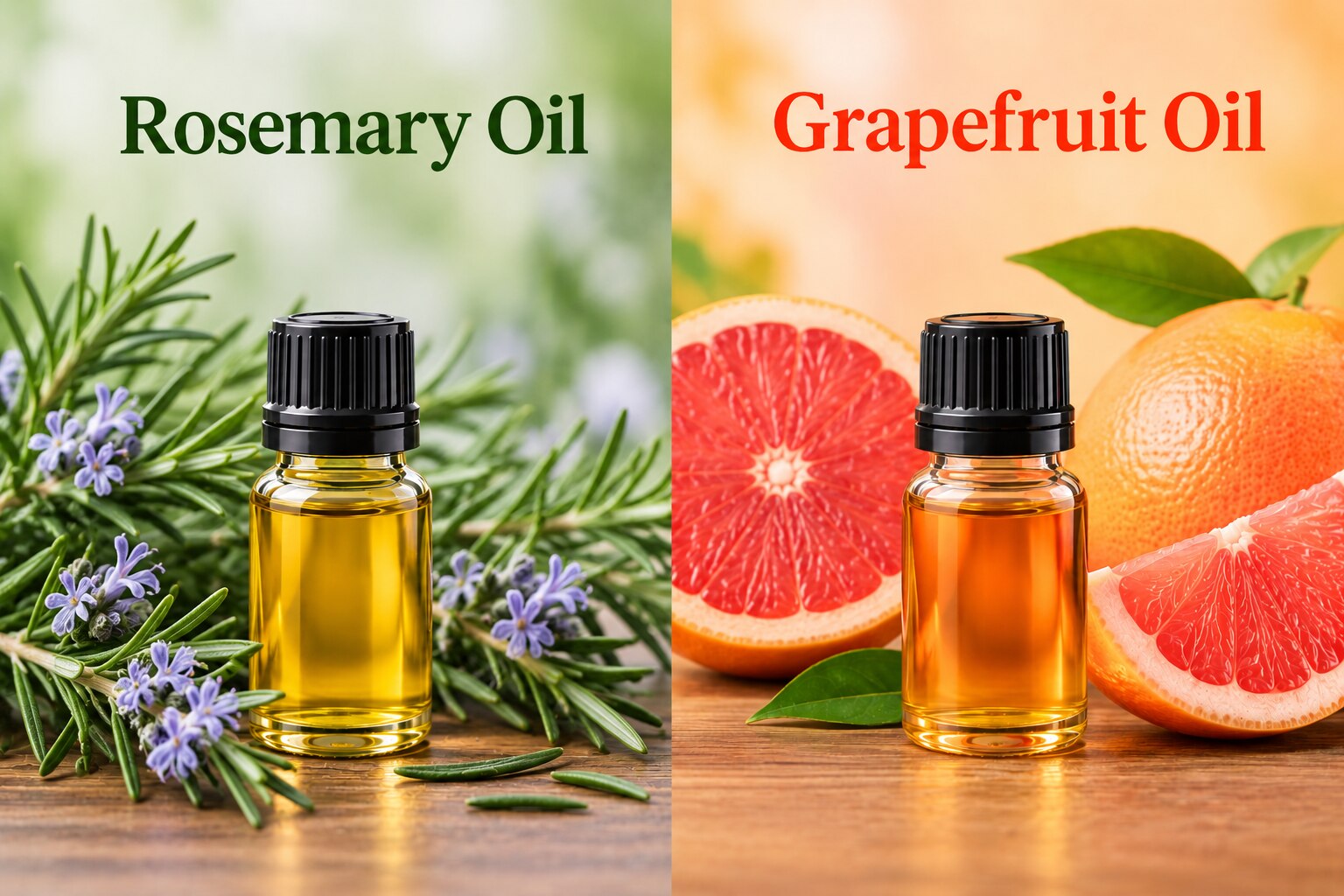
A rosemary leaf oil and an expressed grapefruit peel oil differ before they reach the formulation bench: their raw materials, production methods, chemical profiles, oxidation risks and safety controls are not interchangeable. By comparing the process grade, intended use, test documents and storage conditions, you can select the right oil and reject supplier quotations that use the same name for materially different inputs.
Key takeaways
- Specify rosemary leaf distillation or grapefruit peel expression in the purchase description.
- Match 1,8-cineole and camphor levels to the finished product’s sensory and safety needs.
- Request batch-specific GC-MS, certificate of analysis, origin and processing records.
- Control light, oxygen and grapefruit phototoxicity before approving a formula.
Start with the raw material and production route
Rosemary oil manufacture versus grapefruit oil manufacture compares different raw materials, extraction routes and resulting grades—not two interchangeable aroma liquids. Rosemary oil comes from the leaves and flowering tops of Salvia rosmarinus, formerly Rosmarinus officinalis, while grapefruit oil comes from Citrus paradisi fruit peel.
| Material | Raw material and route | Grades or variables to compare |
|---|---|---|
| Rosemary oil | Steam-distilled herb; oil composition changes with harvest timing, origin and distillery conditions | Camphor-rich, 1,8-cineole-rich or verbenone-rich profiles; leaf versus flowering-top material |
| Grapefruit oil | Mechanically expressed peel, followed by centrifugation, polishing and sometimes winterisation | Standard expressed, distilled, folded or FCF/bergapten-reduced oil; peel origin and processing history |
A rosemary oil manufacturer therefore needs to define the target chemical profile and botanical part before comparing price per kilogram. Distillation also creates supply questions around herb quality, crop timing, batch yield and distillery capacity. A name alone does not identify the material.
Grapefruit oil manufacture carries a different control burden because peel can retain pesticide residues, waxes, post-harvest treatments and juice-processing aids. Request residue and processing declarations alongside the essential-oil certificate of analysis; an attractive citrus odour does not prove clean incoming fruit or adequate separation.
For either quotation, compare botanical name, country and plant part, extraction method, batch size, production date, yield, shelf life, storage conditions, COA, SDS, allergen declaration and IFRA-use information. Also state whether the oil is standard, organic, FCF or otherwise modified. Without those fields, two offers labelled rosemary oil or grapefruit oil are not technically comparable.
Match the oil’s chemistry to the finished product
Choose the oil by chemical profile, not by botanical name alone. Rosemary leaf and flowering-top oil is steam-distilled and may be camphor-rich, 1,8-cineole-rich or verbenone-rich. Grapefruit peel oil is usually expressed and may be standard, distilled, folded or FCF. A bulk rosemary oil quotation is incomplete without its target profile and process grade.
| Application | Rosemary oil | Grapefruit oil |
|---|---|---|
| Personal care | Herbal, assertive and longer-lasting; suits scalp, cleansing and active-style products. | Bright citrus top note; suits washes and creams, but cold-pressed grades raise phototoxicity concerns in leave-on products. |
| Fragrance | Camphor, cineole and woody notes add structure and dry-down. | Limonene-led freshness gives lift but fades faster and can dominate the opening. |
| Food flavour | Use a defined food-grade material with controlled camphor and cineole levels. | Provides peel-like citrus character; verify the intended expressed or distilled grade and flavour-use compliance. |
| Cleaning | Strong herbal character supports disinfectant-style and degreasing fragrances. | Fresh citrus improves consumer appeal, while oxidised limonene can create sensitising components. |
| Industrial | Profile stability matters in coatings, agrochemical odour control and process formulations. | Volatility and oxidation limit applications needing long storage or heat exposure. |
Rosemary is usually less prone to limonene-driven oxidation, but its phenolic and terpene profile still changes odour, colour and compatibility. Grapefruit needs tighter oxygen, heat and light control; FCF or bergapten-reduced material is a separate input, not an interchangeable label.
Do not substitute one for the other when the formula depends on citrus lift, herbal structure or a specified safety profile.
Use documents and batch data to compare suppliers
Two offers represent comparable oil only when they describe the same botanical material, process grade and chemical target. A rosemary oil manufacturer and a grapefruit oil manufacture record must identify the material beyond the label “essential oil.”
| Material | Evidence to compare | What a mismatch means |
|---|---|---|
| Rosemary oil | Salvia rosmarinus, formerly Rosmarinus officinalis; leaves or flowering tops; country of origin; steam distillation; camphor-, 1,8-cineole- or verbenone-led GC-FID or GC-MS profile | Different chemotype, plant part or origin can change odour, density and formulation behaviour |
| Grapefruit oil | Citrus paradisi peel; country of origin; expressed, distilled, folded or FCF grade; bergapten or total furanocoumarin result | Standard expressed oil is not equivalent to FCF or distilled oil |
| Batch evidence | Lot number, batch size, harvest or production date, yield where recorded, and manufacturing site | A quotation without a traceable lot cannot support a like-for-like trial |
| Release documents | COA showing appearance, odour, relative density, refractive index, optical rotation and chromatogram; SDS; allergen declaration; IFRA-use information | Missing data prevents technical approval and safety review |
| Commercial status | Shelf life, storage conditions, and declaration of standard, organic, FCF or otherwise modified material | A lower price may reflect a different grade or remaining shelf life |
Ask for the chromatogram of the offered batch, not a generic specification. Match its major constituents and furanocoumarin status to your approved target, then retain the COA, SDS, declarations and lot-specific purchase record with the trial sample.
Control oxidation, light exposure and grapefruit phototoxicity
Oxidation control starts before the drum is opened. Store bulk rosemary oil and grapefruit oil in tightly sealed, light-resistant containers at a cool, stable temperature, with minimal headspace; repeated warming and cooling pulls moisture-laden air into the pack.
Nitrogen blanketing helps large containers, while an approved antioxidant can help only when its compatibility, concentration and declaration are controlled.
| Oil | Main storage concern | Practical control |
|---|---|---|
| Rosemary oil | Volatile loss and oxidation of sensitive constituents | Keep sealed, cool and dark; record opening date and limit repeated drum access |
| Grapefruit oil | Rapid limonene oxidation and light-sensitive furanocoumarins | Use an opaque, nitrogen-managed pack; minimise headspace and monitor peroxide or oxidation indicators |
Do not approve grapefruit oil for a sun-exposed leave-on product from the name alone. Cold-pressed grapefruit peel oil can contain bergapten and other furanocoumarins that create phototoxicity risk after ultraviolet exposure; request the supplier’s IFRA-use information and analytical result for the relevant limit.
Treat standard expressed grapefruit oil and FCF grapefruit oil as different formulation inputs. “Bergapten-free” is not sufficient evidence: request the documented removal process, specification, batch result and confirmation that the FCF grade was not substituted with ordinary expressed oil.
For each shipment, retain the COA, SDS, allergen declaration and storage instruction. For grapefruit, add pesticide-residue, wax, peel-treatment and processing-aid declarations because fruit-peel contamination can enter during manufacture. Reject material with a broken seal, unexplained colour or odour shift, rising oxidation results, or missing batch traceability.
Test a retained sample before releasing a new lot into production.
Turn the comparison into a procurement specification
Request a named grade, not “rosemary oil” or “grapefruit oil” at a spot price. Your brief to an essential oil supplier in Bengaluru should state the botanical species, country and plant part, extraction or expression method, intended application, annual volume, trial quantity and required delivery pack.
- For rosemary, specify Salvia rosmarinus leaf or flowering-top oil and the target chemotype: camphor-rich, 1,8-cineole-rich or verbenone-rich.
- For grapefruit, specify peel oil as standard expressed, distilled, folded or FCF/bergapten-reduced material, plus the required furanocoumarin or bergapten limit.
- Require batch size, yield or production date, shelf life, storage conditions, COA, SDS, allergen declaration and IFRA-use information.
- Require the COA to report appearance, odour, relative density, refractive index, optical rotation and a GC-FID or GC-MS profile.
- For grapefruit, request pesticide-residue results and declarations covering fruit waxes, peel treatments and juice-processing aids.
- State whether the material must be standard, organic, FCF or otherwise modified.
Trial one representative production batch at the formula’s intended dosage, then compare odour, colour, volatility, solubility, oxidation after accelerated storage and finished-product performance. Do not approve a substitute because its price or headline name matches.
For rosemary oil manufacture versus grapefruit oil manufacture, approve only against a retained sample and written acceptance limits. SHANTI AROMATICS can be assessed on that same document, making its offer comparable with other suppliers rather than accepted on catalogue wording.
Related product
 | Oils ₹1500 CERTIFICATE OF ANALYSIS OF ROSEMARY OIL Product : Rosemary oil Origin : Indian. Colour : yellow colored, clear liquid. View product → |
Frequently asked questions
How do rosemary oil and grapefruit oil differ at the manufacturing stage?
Rosemary oil comes from Salvia rosmarinus leaves and flowering tops, commonly through steam distillation. Grapefruit oil comes from Citrus paradisi peel, commonly through cold expression, so the raw material and processing route differ from the start.
Which chemistry should you compare before choosing an oil?
Compare the batch GC-MS profile and key constituents against the product brief. Rosemary oil commonly requires attention to 1,8-cineole, camphor and alpha-pinene, while grapefruit oil is assessed largely through its limonene-rich citrus profile and the intended sensory result.
What supplier documents should you request for bulk essential oils?
Request a batch-specific certificate of analysis, GC-MS report, batch or lot number, botanical name, plant part, extraction method, country of origin, production date, retest or expiry date, storage conditions and safety data sheet.
How should you control grapefruit oil phototoxicity?
Confirm whether the material is expressed grapefruit oil or a version processed to reduce furanocoumarins, then check the applicable finished-product exposure limits. Protect both oils from heat, light and oxygen, and verify the supplier’s storage and packaging controls.