Lavender and grapefruit oils come from different plant parts and manufacturing routes, so their aroma, stability, contamination profile and documentation needs are not interchangeable. By the end, you can match each oil to a cosmetic format, identify the tests and safety documents to request, and compare suppliers on more than a “natural” claim.
Key takeaways
- Lavender uses flowering tops; grapefruit uses peel from citrus processing.
- Steam distillation and expression produce different yields, aromas and stability profiles.
- Choose by product format, skin exposure, light exposure and scent objective.
- Approve each batch against safety data and a batch-specific specification.
Different plant parts create different oils before processing begins
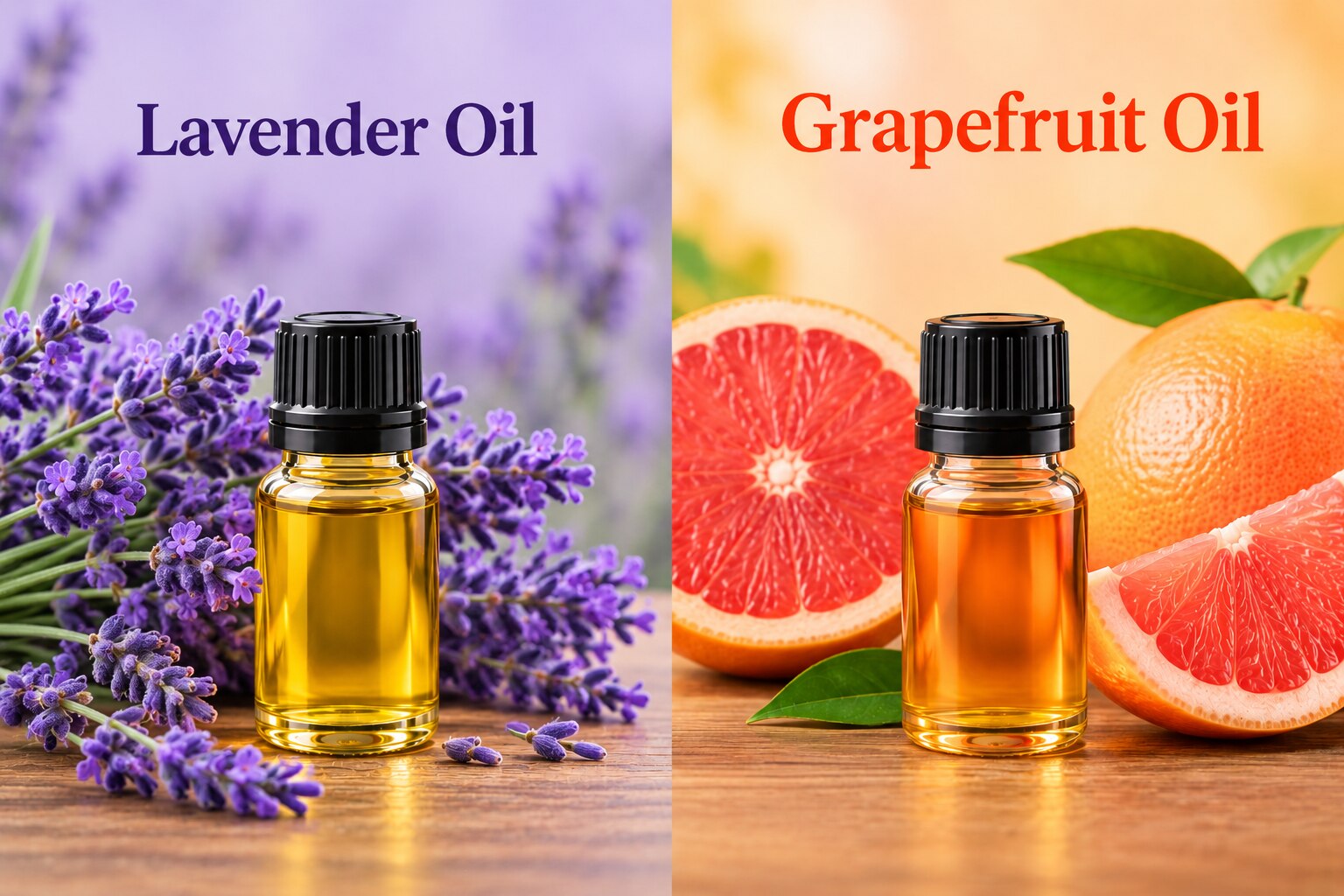
“Lavender oil” and “grapefruit oil” identify different plant materials before extraction begins. Lavender oil manufacture uses the flowering aerial parts of Lavandula angustifolia or another named Lavandula species, usually through steam or hydrodistillation. Grapefruit oil manufacture usually uses the peel, recovered during juice processing by mechanical expression.
| Material | Plant part | Usual route | What is supplied |
|---|---|---|---|
| True lavender oil | Flowering aerial parts | Steam or hydrodistillation | A volatile oil characterised by linalool and linalyl acetate |
| Expressed grapefruit oil | Peel | Mechanical expression, separation and clarification | A limonene-dominant peel oil containing some nonvolatile peel material |
| Distilled grapefruit oil | Peel | Steam distillation | A different peel oil, not interchangeable with expressed oil |
The extraction route changes the material’s identity. Expressed grapefruit oil can retain waxes, pigments, insoluble matter and agrichemical residues, while steam-distilled lavender oil is principally a volatile distillate. Solvent extracts and absolutes are separate products, not substitutes for distilled lavender oil.
Use this procedure before comparing quotations:
- Ask for the botanical name, plant part and extraction method; “lavender oil” alone is incomplete.
- Confirm whether grapefruit is expressed, distilled or rectified, and request any furanocoumarin or bergapten declaration required for the formula.
- Match the lot-specific COA to a GC-FID or GC-MS profile: lavender should show its linalool and linalyl acetate pattern, while grapefruit should show its limonene-dominant pattern.
- Check the production lot, origin and traceability documents rather than accepting “100% pure” or “natural” as the material identity.
Distillation and expression create different yield, aroma and stability trade-offs
Harvest timing and still operation can change lavender oil before a cosmetic brand ever receives it. Lavender oil manufacture usually steam-distills flowering tops, so yield depends on flower condition, moisture and charge size; excessive heat or poor drying can flatten delicate notes or create a harsher profile.
Grapefruit oil manufacture usually expresses fresh peel during juice processing. The process produces an oil with peel waxes, pigments and other nonvolatile material, while distilled grapefruit peel oil is a different grade rather than a direct substitute.
| Route | Yield behaviour | Aroma and processing sensitivity | Stability implication |
|---|---|---|---|
| Steam-distilled lavender | Yield shifts with harvest timing, plant moisture and still loading | Still temperature and drying affect the balance of floral, herbal and camphoraceous notes | Cleaner material is easier to clarify, but heat and oxygen still damage aroma |
| Expressed grapefruit peel | Yield follows peel freshness and expression efficiency; clarification removes suspended material rather than creating more oil | Fresh peel gives a brighter citrus profile, while delayed processing or poor separation increases variation | Limonene-rich oil oxidises readily; residual waxes and pigments complicate consistency and testing |
The phrase lavender oil manufacture grapefruit oil for manufacture combines two different purchasing decisions. For grapefruit oil for manufacture, ask whether the lot is expressed, distilled or rectified, then set limits for insoluble matter, pesticide residues and peroxide value.
Expressed grapefruit oil needs stronger oxygen control than distilled lavender: use light-protective, low-headspace packaging, cool storage and a defined retest date. Compare aroma against an approved reference sample, not only a generic specification, because a matching botanical name does not guarantee matching scent or shelf-life.
Choose the oil by product format, exposure and scent objective
Match the oil to where it sits on skin or hair and to the scent you want after dilution. Lavender suits soft, herbal-floral products and is the safer starting point for leave-on concepts; grapefruit gives a sparkling citrus lift but needs tighter oxidation and phototoxicity control.
| Format | Better choice | Decision |
|---|---|---|
| Serum | Lavender | Use for a gentle floral-herbal profile; check linalool and leave-on allergen levels. |
| Shampoo | Either | Choose lavender for a calming herbal identity or grapefruit for a fresh, clarifying impression. |
| Soap | Lavender | Its rounded aroma performs better through alkaline processing; grapefruit’s top note can fade. |
| Lotion | Lavender | Prefer it for a lasting botanical character; use grapefruit only with phototoxicity controls. |
| Cleanser | Grapefruit | Rinse-off exposure suits its bright citrus profile, but protect the oil from heat, air and light. |
| Fragrance | Either | Lavender supports the heart; grapefruit supplies a volatile top note. Confirm the IFRA limit for the finished product. |
Lavender oil manufacture should name the Lavandula species, chemotype, flowering aerial parts, and steam or hydrodistillation method; an absolute is not interchangeable. A purchase brief for grapefruit oil for manufacture should identify expressed peel, distilled peel or furanocoumarin-reduced material and provide supporting data.
For EU products, calculate limonene and linalool declarations from actual dosage: 0.001% for leave-on and 0.01% for rinse-off.
Use safety data and a batch-specific specification before approval
Do not approve either oil from a catalogue name or generic COA. Release the exact lot only after its safety data matches a batch-specific specification.
| Oil | Identity and quality checks | Safety evidence |
|---|---|---|
| Lavender | Lavandula angustifolia or named species and chemotype; flowering aerial parts; steam or hydrodistilled; GC profile and physical constants | SDS, allergen declaration, pesticide and contaminant results |
| Grapefruit | Citrus paradisi peel; cold-pressed, distilled or furanocoumarin-reduced; GC profile, physical constants and bergapten result | SDS, phototoxicity information, allergen declaration, pesticide and contaminant results |
Ask the cosmetic essential oil supplier for:
- A lot-specific COA showing batch number, production date, retest date, origin, extraction method, appearance, odour, density, refractive index, optical rotation and GC profile.
- An SDS in the current GHS format, plus traceability from the finished lot to the incoming botanical material.
- An allergen declaration that reflects the actual lot. Calculate limonene and linalool in your finished formula; under EU rules, declare each above 0.001% in leave-on products or 0.01% in rinse-off products.
- For grapefruit, a bergapten and total furanocoumarin statement when the product remains on skin or receives sun exposure.
A certificate claiming ISO 22716 does not prove that every oil batch meets an essential-oil identity standard; ISO 22716 primarily covers finished cosmetic GMP. If you assess SHANTI AROMATICS or a lavender oil supplier in Bengaluru, verify the distillation location, transit and warehouse conditions, and lot-level documentation rather than assuming local supply means local manufacture.
Related products
 | ESSENTIAL OIL ₹1800 COA OF LAVENDER OIL ----------------------------------------------------------------------------------------------- TEST SPECIFICATION RESULT... View product → |
 | ESSENTIAL OIL ₹2500 Essential oil View product → |
Compare suppliers on traceability, consistency and total formulation effort
Compare suppliers on three outputs: traceability, consistency and the formulation work their batches create.
| Criterion | Lavender oil supplier | Grapefruit oil supplier | Evidence to compare |
|---|---|---|---|
| Traceability | Botanical name, flowering plant part, distillation site and harvest lot | Citrus peel source, expression or distillation site and peel lot | Lot number, origin, production date, storage history and chain back to the incoming material |
| Consistency | Linalool, linalyl acetate and related constituents in a GC-FID or GC-MS profile | Limonene-dominant GC-FID or GC-MS profile, plus expressed or distilled grade | Batch-specific COA, physical constants and permitted profile range |
| Formulation effort | Variation can alter floral intensity and odour balance | Oxidation, allergen changes and phototoxicity controls can add review work | Allergen declaration, SDS, pesticide or contaminant data and furanocoumarin statement |
Ask a lavender oil supplier in Bengaluru where distillation occurred; local warehousing does not prove local manufacture. Confirm temperature-controlled transit and storage, then reject a supplier that offers only a catalogue specification instead of lot-level documents.
A cosmetic essential oil supplier should update the allergen declaration when crop, origin, processing or storage age changes. For EU products, calculate limonene and linalool from the actual dosage and batch composition: declaration begins above 0.001% in leave-on products and 0.01% in rinse-off products.
Do not treat ISO 22716 as proof of an essential-oil identity standard. It addresses finished-cosmetic production controls; your decision still requires batch identity, composition and traceability evidence. Choose the supplier whose documentation reduces reformulation, safety review and release delays—not merely the lowest quoted price.
Frequently asked questions
Which plant parts are used for lavender and grapefruit oil manufacture?
Lavender oil manufacture uses the flowering aerial parts of a named Lavandula species. Grapefruit oil manufacture uses grapefruit peel, usually recovered during juice processing.
How do distillation and expression affect these oils?
Steam or hydrodistillation separates lavender oil from plant material, while mechanical expression releases grapefruit peel oil. The methods create different yield, aroma and stability trade-offs.
How should cosmetic brands choose between lavender and grapefruit oil?
Choose according to the product format, skin exposure, light exposure and desired scent. Grapefruit oil also requires careful review of its safety profile for the intended use.
What should you request before approving a cosmetic essential oil supplier?
Request safety data, a batch-specific specification, botanical identity, extraction method, batch number, origin details and test results that demonstrate consistent quality.
Related product
 | essential oil ₹2500 Natural & pure View product → |