Choosing between these oils affects more than the fragrance brief: extraction method, phototoxicity, citral content, oxidation, colour, and finished-product dosage all change the formulation decision. By comparing their sensory roles, format suitability, safety documentation, and sourcing requirements, you can select the material that fits your product rather than substituting one citrus note for another.
Key takeaways
- Choose grapefruit for a bright top note; choose lemongrass for a stronger citrus-herbal signature.
- Check phototoxicity, citral content, oxidation risk, and product-specific limits before approval.
- Set usage levels from the finished product category, IFRA guidance, and supplier documentation.
- Request batch-specific GC-MS, certificate of analysis, SDS, allergen declaration, and origin details.
How do grapefruit oil and lemongrass oil differ in fragrance and formula role?
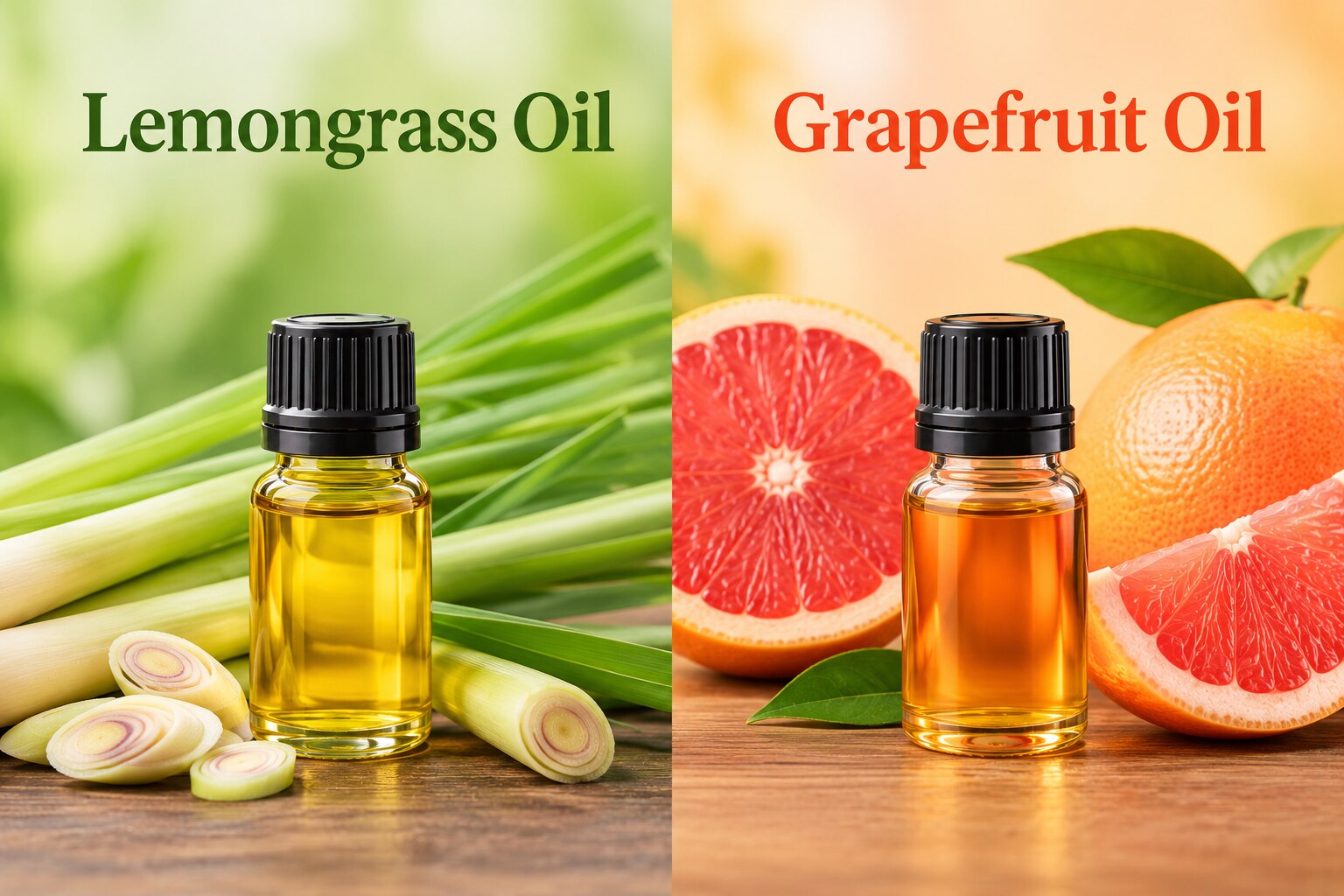
Grapefruit oil usually lifts a fragrance; lemongrass oil is more likely to define it. Grapefruit oil is a citrus peel oil with a fresh, bright, sparkling top note that fades relatively quickly. Lemongrass oil brings a stronger lemon-citral character, with grassy and herbal facets that can dominate a blend.
Grapefruit oil manufacture matters: expressed or cold-pressed peel oil and steam-distilled oil do not share the same composition. Expressed oil is commonly limonene-rich, while distillation changes the volatile profile and can reduce nonvolatile peel constituents.
For lemongrass oil for cosmetics, specify Cymbopogon flexuosus or Cymbopogon citratus; species, origin, harvest, and distillation affect citral content and odour.
| Feature | Grapefruit oil | Lemongrass oil |
|---|---|---|
| Top-note brightness | High, sparkling citrus lift | Bright but sharper and more forceful |
| Lemon intensity | Fresh grapefruit-citrus impression | Strong lemon-citral character |
| Persistence | Usually shorter; fades from the opening | Often more noticeable for longer |
| Colour risk | Lot-dependent yellow or green tint | Lot-dependent yellow to amber tint |
| Formula role | Lifts and freshens a blend | Defines or strongly reshapes a blend |
| Substitution difficulty | Not interchangeable with lemongrass | Requires fragrance rebalancing |
A grapefruit oil manufacture versus lemongrass oil for cosmetics comparison is therefore a choice between a volatile citrus accent and a dominant citral material. Replacing one with the other requires new sensory, colour, and stability checks.
Which oil fits soaps, shampoos, body washes, creams, lotions, and candles?
Choose grapefruit oil for a fresh citrus opening in soaps, shampoos, body washes, lotions, and home-fragrance products. Its volatile top note fades quickly, so support it with longer-lasting citrus, woody, or floral materials. Choose lemongrass oil for a recognisable lemon-citral identity in soaps, shampoos, body washes, candles, and room fragrances.
| Format | Better fit | Main watchpoint |
|---|---|---|
| Soaps, shampoos, body washes | Grapefruit for brightness; lemongrass for stronger lemon identity | Rinse-off exposure still requires allergen and safety review |
| Creams and lotions | Grapefruit for a lighter citrus lift | Lemongrass can overwhelm delicate emulsions and leave a dominant odour |
| Candles and room fragrances | Lemongrass for persistence and character; grapefruit for a sparkling opening | Rebalance for hot throw and fragrance retention |
Rinse-off products, leave-on cosmetics, and candles perform under different exposure and heat conditions. Check colour contribution and smell after storage: an emulsion can develop a different odour from the neat oil, while oxidation can reduce freshness and increase off-notes.
Test each oil in the actual base at its intended concentration, not only on a blotter. A blotter cannot predict emulsion odour, colour shift, candle throw, or fragrance retention.
Neither oil is ideal when you need low phototoxicity risk, extreme persistence, or tight colour control. Use a controlled citrus fraction, an aroma chemical, or a fragrance compound instead. For lemongrass oil for cosmetics, confirm that its assertive citral profile suits the finished product before approval.
What safety and stability checks change the choice?
The choice between grapefruit oil manufacture versus lemongrass oil for cosmetics often turns on phototoxicity, sensitisation, and oxidation—not fragrance alone. For grapefruit, request the extraction method and classify the material as expressed, steam-distilled, FCF, or bergapten-controlled.
Expressed peel oil can contain furocoumarins, including bergapten; check quantified results, the finished-product leave-on-use limit against the current IFRA standard, and destination-market rules. “Natural” and “pure” do not prove phototoxicity status.
For lemongrass oil for cosmetics, review citral, geranial, and neral declarations. Citral can drive skin-sensitisation concerns and dominate odour; check allergen labelling thresholds, including EU declaration triggers of 0.001% in leave-on and 0.01% in rinse-off products, alongside current transition requirements.
Both limonene-rich grapefruit oil and citral-rich lemongrass oil need oxidation control. Use light-protective, tightly closed packaging, minimise headspace, and record opening dates. Assess odour and colour after accelerated and real-time stability testing because oxidation can create sensitising degradation products.
Before approval, run this checklist:
- Obtain lot-specific composition and extraction data; do not substitute a controlled FCF grade for expressed oil without reformulation review.
- Check IFRA category limits and destination-market rules for the finished use.
- Complete the finished-product safety assessment. Allergen declarations and IFRA guidance inform it; neither replaces it.
How much essential oil should you add to a cosmetic formula?
Do not choose a universal percentage for grapefruit or lemongrass oil. Calculate each essential oil’s concentration in the finished cosmetic, not only its percentage in the fragrance blend.
1. Use this calculation: finished-product percentage = fragrance-blend percentage × essential-oil percentage within that blend ÷ 100.
2. For example, a fragrance blend used at 0.50% and containing 20% grapefruit oil contributes 0.10% grapefruit oil to the finished product.
3. Check the permitted level against the product category, leave-on or rinse-off exposure, phototoxicity status, allergen content, destination market, and the current IFRA certificate for the intended use. An IFRA certificate guides fragrance-material use; it does not replace a finished-product safety assessment.
4. For lemongrass oil for cosmetics, review citral, geranial, and neral data. For grapefruit oil, review limonene and relevant furocoumarin information before approving a target level.
5. Make small pilot batches at the proposed concentration, then check odour, colour, emulsion behaviour, packaging compatibility, and stability. Repeat the assessment after heat, light, and storage exposure because oxidation can change both odour and sensitisation risk.
Approve the dose only after these results match the formula, packaging, market, and intended use. A fragrance blend that smells balanced at 0.50% can still deliver too much of one restricted or sensitising component.
What should you request from a supplier before approving either oil?
Approve neither oil from a generic specification sheet. Request a lot-specific document pack that lets you identify the material, assess its intended use, and trace it back to production.
1. Request a current COA naming the batch number, production date, retest date or shelf life, botanical name, plant part, geographic origin, extraction method, physical constants, storage conditions, and actual lot results. Add the SDS, allergen declaration, contaminant statement, and IFRA certificate for the intended cosmetic use.
2. Ask for a GC-MS or GC-FID chromatogram, or a defined specification range, when your quality system requires it. A COA confirms selected test results for one lot; it does not establish cosmetic-use compliance or phototoxicity status by itself.
3. For grapefruit oil, identify whether grapefruit oil manufacture produced an expressed, steam-distilled, FCF, or bergapten-controlled material. Request quantified furocoumarin or bergapten data for leave-on products. For lemongrass, confirm the species, such as Cymbopogon flexuosus or Cymbopogon citratus, plus citral, geranial, and neral values.
4. Ask for evidence that lemongrass was not blended with synthetic citral or carrier material without disclosure. Check distillation site, crop origin, traceability, compatible packaging, headspace, and storage temperature.
When assessing a lemongrass oil supplier in Mumbai, treat the Mumbai address as a dispatch location, not proof of origin. SHANTI AROMATICS may be considered as a B2B source for documented bulk essential oils for cosmetic brands, but your own sample, document, and finished-product qualification process remains necessary.
Frequently asked questions
How do grapefruit oil and lemongrass oil differ in fragrance and formula role?
Grapefruit oil gives a fresh, sparkling citrus top note that fades faster. Lemongrass oil delivers a stronger lemon-citral, grassy, herbal character that can define the blend.
Which oil fits soaps, shampoos, body washes, creams, lotions, and candles?
Grapefruit suits bright citrus profiles and lighter fragrance effects. Lemongrass suits formulas needing a persistent, assertive citrus-herbal identity. Test each oil in the finished base and product category.
What safety and stability checks change the choice?
Review phototoxicity data, citral and allergen declarations, oxidation risk, colour, odour stability, and compatibility with the formula. Apply the correct IFRA standard for the finished product.
How much essential oil should you add to a cosmetic formula?
Start with a controlled lab trial, then set the level using the finished-product category, IFRA guidance, supplier limits, and your safety assessment. Do not copy a dosage from another product.
What should you request from a supplier before approving either oil?
Request a batch-specific certificate of analysis, GC-MS report, SDS, allergen declaration, botanical name, plant part, extraction method, country of origin, lot number, and shelf-life or storage guidance.