Choosing between lemongrass oil, citronella oil, lemon oil and isolated citral affects more than fragrance: it changes the finished product’s odour, colour, stability, safety review and claim strategy. By the end, you will know how to specify each oil, assess manufacturing value and select a material that fits your product format and regulatory pathway.
Key takeaways
- Match lemongrass to citral-led profiles and citronella to herbal, geraniol-rich profiles.
- Compare natural oil with lemon oil and synthetic citral by aroma, consistency and claims.
- Request a COA, GC-MS report, SDS and batch traceability before approving bulk oil.
- Store essential oils in sealed, light-protective containers away from heat and air.
Which product role fits lemongrass oil or citronella oil?
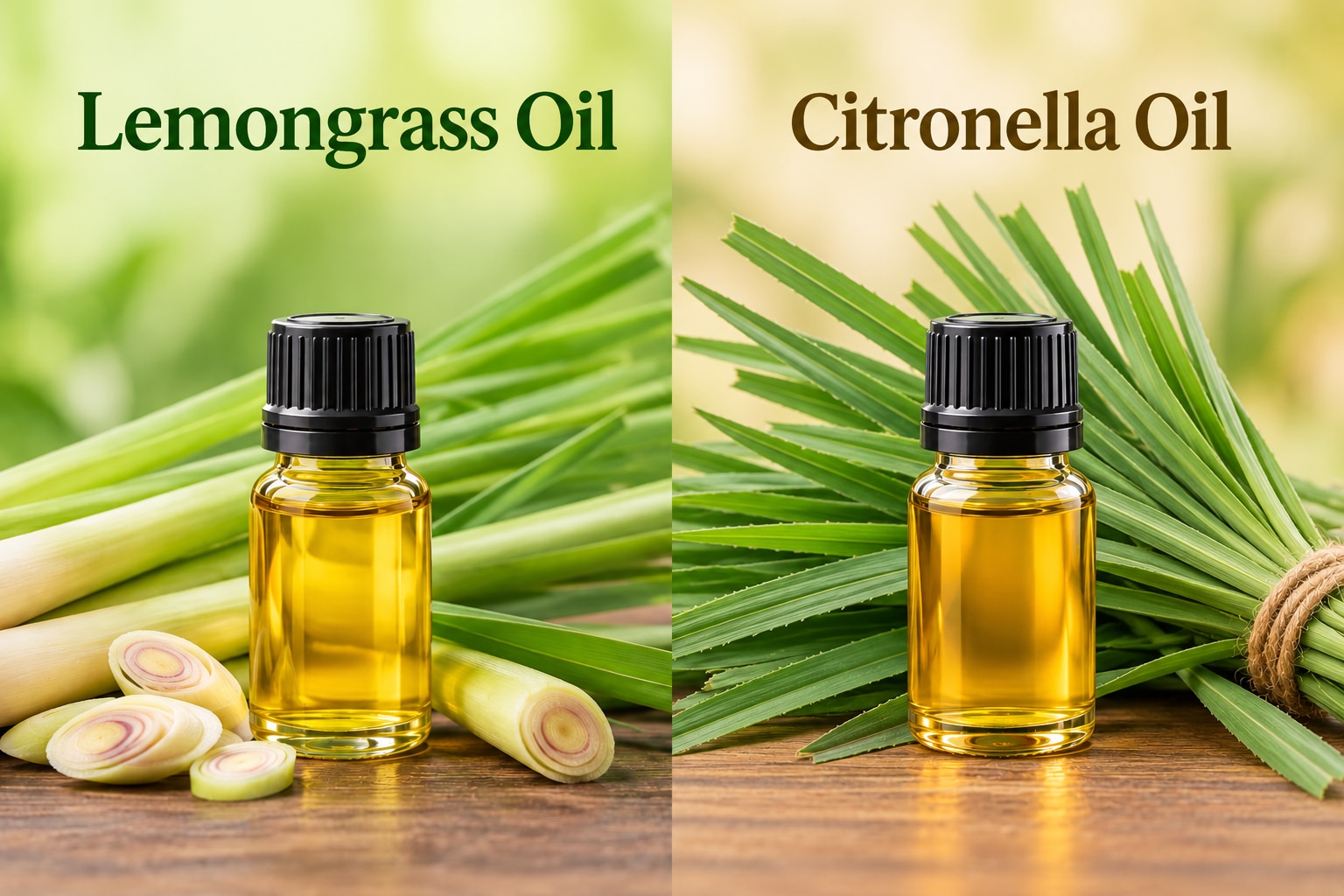
Lemongrass oil suits a sharp, citral-led citrus impression; citronella oil suits a more herbal, citronellal-geraniol direction. The practical lemongrass oil and citronella oil manufacture benefits depend on matching that chemistry to the finished product, not treating both as interchangeable “citrus oils.”
| Option | Chemical identity | Best product role |
|---|---|---|
| Lemongrass oil | Cymbopogon flexuosus or Cymbopogon citratus; citral means geranial plus neral | Bright fragrance in soaps, shampoos and household cleaners; citrus lift in candles, diffusers and room sprays |
| Java citronella | Cymbopogon winterianus; valued for citronellal, citronellol and geraniol | Herbal fragrance in soaps, shampoos, candles, diffusers and sprays; suitable for repellent-oriented briefs |
| Ceylon citronella | Cymbopogon nardus; a distinct chemotype and source | Fragrance or repellent development only after profile and performance testing; not a universal Java substitute |
Cymbopogon flexuosus, commonly East Indian lemongrass, and Cymbopogon citratus, commonly West Indian lemongrass, can show different citral patterns and sensory sharpness. Use lemongrass for a cleaner citrus effect; use citronella when herbal persistence and repellent positioning matter. A repellent claim still requires the correct safety and regulatory pathway.
Before buying, request:
- Botanical name, plant part, country, harvest region and extraction method
- Lot number and lot-specific GC-FID or GC-MS profile
- Production date, density, refractive index and oxidation indicator
Reject a specification that says only “citronella” or “100% pure.”
When should you choose natural oil, lemon oil or synthetic citral?
Choose lemongrass oil for a layered, grassy citrus profile; choose citronella for a sharper herbal direction; choose lemon oil for familiar brightness; choose synthetic citral for composition and cost control.
| Option | Best fit | Product-development effect |
|---|---|---|
| Lemongrass oil | Natural, layered citral-led character | Bulk lemongrass oil brings minor constituents, but colour, oxidation, persistence and lot variation require control. |
| Citronella oil | Citronellal-geraniol fragrance or repellent-oriented briefs | More herbal and persistent; composition varies by chemotype, affecting odour, acceptance and performance. |
| Lemon oil | Bright, recognisable citrus identity | Consumer familiarity is strong, but colour and oxidation can shift with the oil’s composition and storage. |
| Synthetic citral | Tight composition, colour control and repeatability | Predictable batches and costing, with a simpler profile that may feel less natural to consumers. |
Natural oils can darken or vary more than synthetic citral. Oxidation from air, heat and light changes odour and can increase unwanted oxidation products, while synthetic citral supports tighter specifications but still needs stability testing.
Do not equate higher recovery with better oil. Prolonged distillation can increase darkness, harshness or non-volatile carryover and push the profile outside specification.
Use this decision checklist:
- Target odour: grassy, herbal, bright or defined citral
- Acceptable finished-product colour
- Citral or citronellal range
- Oxidation limit and stability method
- Allergen declaration, including citral, geraniol, citronellol, limonene or linalool
- Validated fragrance, sensory or repellent performance
How do you formulate and handle these oils safely?
Dose the finished formula, not the natural ingredient. For essential oils for natural product brands, the intended use, exposure route, target market and toxicological assessment determine the level; “natural” does not make concentrated oil automatically safe.
| Format | Handling point |
|---|---|
| Cold-process soap | Add at trace after the lye solution has cooled; verify skin-safe dosage, acceleration and scent retention. |
| Melt-and-pour soap | Add below the supplier’s validated temperature, then mix thoroughly without overheating volatile components. |
| Shampoo, cleanser and cream | Pre-dilute into the oil phase or solubiliser, check skin dilution and preservative compatibility, and assess rinse-off versus leave-on exposure. |
| Candle | Use the wax supplier’s fragrance-load limit, test hot throw and cold throw, and check wick performance and flash-point documentation. |
| Reed diffuser and room spray | Match the oil to the base and diffuser material; test evaporation, inhalation exposure, staining and ventilation requirements. |
| Surface cleaner | Confirm compatibility with the surfactant system, eyes and skin warnings, spray inhalation exposure, and cleaning performance. |
Lemongrass and citronella can contain citral, geraniol, citronellol, limonene and linalool. These can sensitise skin. EU cosmetic allergen thresholds differ for leave-on and rinse-off products, while Regulation (EU) 2023/1545 introduces expanded labelling and transition deadlines.
Wear chemical-resistant gloves and eye protection, provide ventilation, control ignition sources and treat the oils as flammable materials. Citronella alone does not prove insect-repellent performance; a pesticidal claim in the United States can trigger EPA requirements.
Store oils in tightly closed compatible containers with minimal headspace, away from light, heat and ignition. Use cool storage, then run finished-product stability testing for odour, colour, separation and packaging compatibility.
What manufacturing benefits should a brand demand from its supplier?
A controlled batch reduces formulation and supply risk by making each lot explainable. Ask for raw-material identity, botanical name, plant part, harvest region, drying and chopping controls, steam rate, distillation time, condenser performance, filtration or redistillation records, blending records and post-distillation storage conditions.
| Evidence to request | Risk it controls | Business use |
|---|---|---|
| Batch record and chain of custody | Unknown origin or altered material | Trace complaints and compare lots |
| Certificate of analysis | Off-specification oil entering production | Approve or reject incoming material |
| Storage and blending records | Oxidation or inconsistent composition | Protect formula repeatability |
The certificate of analysis should show density, refractive index, optical rotation where relevant, acid value or another oxidation indicator, production date, retest or shelf-life date, lot number and lot-specific GC-FID or GC-MS results. These records help you plan lead times, investigate complaints, scale a formula and separate harvest variation from manufacturing failure.
For a lemongrass oil supplier in Mumbai or citronella oil supplier in Mumbai, ask whether the company is a distiller, importer, stockist or trader. A Mumbai commercial address does not prove Mumbai distillation origin; request the distillation site, original producer’s lot number and any blending or redistillation history.
Shanti Aromatics is worth evaluating as a potential partner only against those traceability, documentation, consistent-specification and scale-up criteria. Controlled lots give brands a defensible basis for approving substitutes, scheduling production and adjusting formulas without guessing.
Related product
 | Lemongrass oil ₹1100 CERTIFICATE OF ANALYSIS OF LEMONGRASS OIL Product : Lemongrass oil Colour : Pale yellow to orange brown liquid . View product → |
How should you approve, store and scale the chosen oil?
Approve the supplier on total product fit, not on price per kilogram or yield alone. For bulk lemongrass oil and citronella oil, compare:
| Measure | What to compare | Why it matters |
|---|---|---|
| Chromatography | Compliant GC-FID or GC-MS range | Confirms identity and detects atypical additions |
| Sensory quality | Agreed colour and odour profile | Prevents harsh or dark material entering production |
| Oxidation status | Peroxide or other agreed oxidation indicator | Protects odour quality and stability |
| Supply control | Traceability and consistency across lots | Reduces harvest and substitution risk |
| Commercial result | Delivered cost, including freight and losses | Shows the real cost of usable material |
A citral-standardised lemongrass oil or citronellal-adjusted citronella blend is a modified material. Document the adjustment, resulting composition and blending records; do not present it as an equivalent single-origin oil.
Retain an approval sample and use it as the sensory reference. For each incoming lot:
- Check the lot against the agreed GC range.
- Record the container type, seal condition, headspace and storage temperature.
- Keep containers tightly closed, cool and protected from light.
- Investigate any change in odour, colour or oxidation status before release.
Validate the package and finished product through accelerated stability testing. A nominal raw-material shelf life does not automatically transfer to a shampoo, cleaner, candle or other finished formula.
For essential oils for natural product brands, select the oil whose botanical identity, chemical profile, safety data, claim pathway and supply controls match the product brief.
Frequently asked questions
Which product role fits lemongrass oil or citronella oil?
Choose lemongrass oil for a sharp, citral-led citrus impression. Choose citronella oil for a more herbal profile shaped by citronellal and geraniol.
When should you choose natural oil, lemon oil or synthetic citral?
Choose based on the required aroma, natural-positioning claim, batch consistency and formulation performance. Lemon oil provides a different citrus profile, while synthetic citral offers a more defined single-ingredient option.
How should you formulate and handle lemongrass and citronella oils safely?
Check the supplier’s SDS, follow the stated handling controls, use the oil at a validated level, and assess skin, inhalation and product-specific safety requirements before scale-up.
What should a brand demand from its essential-oil supplier?
Request a certificate of analysis, GC-MS profile, SDS, batch number, origin details, packaging specification and traceability records before approving bulk lemongrass oil or citronella oil.