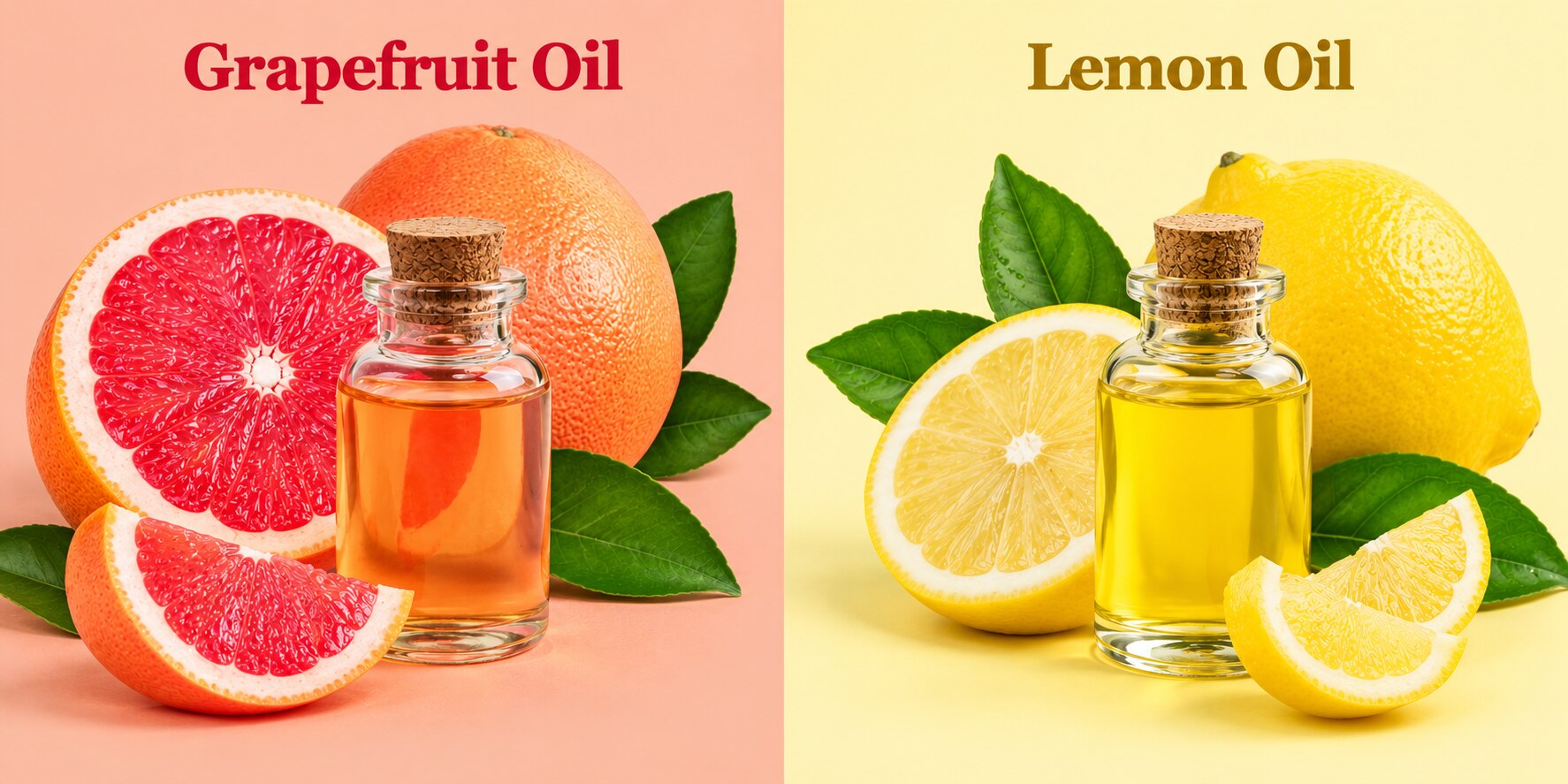
Choosing between grapefruit and lemon oil starts with the oil’s form, not its price or limonene percentage. By comparing manufacture, composition, sensory behavior, stability, authenticity evidence and buying documents, you can select the material that performs predictably in your finished flavor.
Key takeaways
- Specify peel source, extraction method, season and oil-fold status.
- Compare optical rotation, refractive index, aldehydes and peroxide value.
- Check batch documents before testing a bulk citrus-oil delivery.
- Run dilution, aroma, colour and stability checks before production approval.
How expressed grapefruit and lemon oils are actually manufactured
Fruit peel, not dried botanical material, is the starting point for commercial expressed citrus oil. In grapefruit oil manufacture and lemon oil manufacture, processors usually integrate extraction with juice production: peel is abraded or punctured under water, creating an oil-water emulsion.
1. Screen the emulsion to remove peel solids.
2. Centrifuge it to separate the oil-rich phase from water and suspended material.
3. Polish or filter the recovered oil, then store it in sealed, low-oxygen containers before filling.
4. Send the spent peel for further extraction or drying. Steam-distilling dried peel is a different route and produces a different aroma balance.
| Form | What the process means | What you are buying |
|---|---|---|
| Expressed or cold-pressed | Mechanical peel abrasion followed by separation; retains pigments, waxes, nonvolatile compounds and some furanocoumarins | Full peel character, with greater color and oxidation-management needs |
| Distilled | Steam carries volatile compounds from peel or peel material; most nonvolatile components remain behind | A cleaner, often altered aroma profile with less wax and pigment |
| Folded or concentrated | Terpenes are selectively removed or the oil is concentrated, commonly to a stated fold strength | Higher-impact oil whose composition is not equivalent to single-fold expressed oil |
| Isolated d-limonene | A separated major terpene fraction rather than whole peel oil | Limonene character without the minor constituents that create authentic grapefruit or lemon complexity |
Request the exact form, process description and chromatographic profile. A high limonene result alone cannot prove expressed identity, especially after rectification or fractionation.
Why grapefruit and lemon oil behave differently in a formula
A grapefruit oil manufacture versus lemon oil comparison starts with yield, but yield alone is a poor buying rule. Peel-oil recovery depends on fruit variety, peel condition, expression efficiency and whether the material is later distilled, deterpenated or folded.
Both expressed oils are limonene-rich; lemon’s citral fraction—neral and geranial—plus gamma-terpinene and beta-pinene gives sharper peel brightness. Grapefruit combines high limonene with sulfur-containing and oxygenated compounds that create its bitter, distinctive top note. Remove those traces through aggressive fractionation and the result can smell like generic citrus.
Cold-pressed or expressed oils retain pigments, waxes and nonvolatile peel material, so color, haze and sensory variation change by lot. Distilled oil is cleaner and paler, while folded oil is a stronger, altered fraction; isolated d-limonene supplies citrus lift but not lemon or grapefruit identity.
Lemon oxidizes and drifts faster, while grapefruit’s main risk is losing trace character during processing.
| Application | Lemon | Grapefruit |
|---|---|---|
| Beverages | Clean, citral brightness | Bitter-citrus complexity; check color |
| Confectionery | Sharp peel flavor | Distinctive bitterness at controlled dosage |
| Bakery | Familiar lemon lift | Darker citrus profile after heating |
| Dairy | Bright profile in an emulsion | Check bitterness and emulsion color |
| Savory foods | Broad lemon-peel freshness | Bitter, aromatic peel accents |
| Fragrance | Citral-led top note | Sulfurous, high-limonene citrus top note |
Approve the form against the finished product, not limonene percentage or price per kilogram.
Which quality tests reveal identity, oxidation and adulteration
Compare the lot-specific certificate of analysis with a retained authentic reference, not with the product name. ISO 3054 gives a starting point for expressed grapefruit oil; ISO 855 does the same for expressed lemon oil. Neither standard alone proves that a flavor-grade shipment is unadulterated.
| Oil | Identity figures to compare | Quality and fraud checks |
|---|---|---|
| Grapefruit | Refractive index, density, optical rotation, limonene level, GC-FID or GC-MS fingerprint, and chiral markers | Peroxide value, aldehyde profile, residue on evaporation, pesticide residues, solvent residues, and added terpene or other citrus-oil markers |
| Lemon | Refractive index, density, optical rotation, limonene-to-citral balance, GC fingerprint, and chiral markers | Peroxide value, neral and geranial, residue on evaporation, pesticide residues, solvent residues, and evidence of folding or low-cost terpene addition |
In grapefruit oil manufacture and lemon oil manufacture, physical constants alone are easy to imitate. Require the chromatogram, peak-identification method, test dates, and comparison against a retained lot; a high limonene result does not establish authenticity.
For lemon, check peroxide or another stated oxidation limit because an old oil can pass limonene testing while smelling harsh, piney, or turpentine-like.
Ask whether “lemon oil” is expressed, distilled, folded, or isolated d-limonene. A folded oil must state its fold level and process, since concentration changes citral, terpene hydrocarbons, and minor odorants. Also record lot number, origin, packaging, headspace, storage temperature, minimum remaining shelf life, microbiological status, allergens, and intended food use in India.
How to write a useful bulk citrus-oil buying specification
For bulk lemon oil in Mumbai, request a lot-specific specification and certificate of analysis, not a quotation labelled only “lemon oil.” State the intended use—food flavouring in India—and define the oil form before comparing prices.
- Name the botanical source, expressed, distilled or folded form, country and harvest season, lot number, pack size, minimum remaining shelf life and storage conditions.
- Require density, refractive index, optical rotation, residue on evaporation and a GC-FID or GC-MS profile showing limonene, citral and key minor constituents. Specify the fold level and process for folded oil.
- Set limits for peroxide or other oxidation indicators, pesticide residues, solvent residues where applicable, allergens and microbiological status of the supplied preparation.
- Request adulterant screening that compares the chromatogram with a retained authentic lot. Add chiral or enantiomeric testing when substitution with cheap terpene fractions or another citrus oil is a transaction risk; density and limonene alone will not expose it.
- Obtain a furanocoumarin and phototoxicity declaration. Expressed lemon oil can contain bergapten-related compounds, so apply the relevant IFRA restriction when skin or incidental external exposure is possible.
ISO 855 provides a starting point for expressed lemon oil, but it does not replace commercial controls. Evaluate SHANTI AROMATICS by checking whether its lot documents answer every point, the sealed container has low headspace and light protection, and a retained sample matches the declared aroma and GC profile.
A harsh, piney odour signals oxidation even if limonene passes.
Related items
 | essential oil ₹800 CERTIFICATE OF ANALYSIS OF LEMON OIL Product : Lemon oil Origin : Indian . View product → |
| NATURAL ESSENTIAL OILS ₹800 CERTIFICATE OF ANALYSIS OF LEMON OIL Product : Lemon oil Origin : Indian . View service → |
How to bench-test the oils before approving a production lot
Approve the oil only after testing it in the finished product at the intended dosage, not in a neat smelling strip. The grapefruit oil manufacture versus lemon oil choice can change emulsion stability, bitterness, heat loss and oxidation even when both oils meet a limonene specification.
Test matched formulas using the same water, acid, sweetener, emulsifier and oil concentration. Record appearance, aroma, flavor and separation at each checkpoint.
| Oil | Emulsion and processing observation | Storage and sensory risk |
|---|---|---|
| Grapefruit | Check haze, ring formation and droplet separation; heat can reduce its trace grapefruit character while leaving strong limonene | Track bitterness and harsh peel notes after carbonation and storage |
| Lemon | Check emulsion stability after heat and carbonation; citral impact can shift as the formula ages | Monitor peroxide or oxidation status and reject piney, turpentine-like or flat notes |
| Both | Compare pre-process and post-process samples from the same batch | Use identical containers, headspace, light exposure and temperature |
Run the trial in this order:
- Measure each oil into the finished emulsion, then inspect immediately and after the product’s actual filling process.
- Apply the real heat cycle and carbonation pressure. Compare aroma loss, haze, oil rings and bitterness against an untreated control.
- Store sealed samples under the intended warehouse and market conditions, plus a defined heat-and-light stress condition.
- Recheck at fixed intervals for separation, color, bitterness, harsh oxidation and loss of citrus character. Retain a reference lot and approve only when the new lot matches it.
Frequently asked questions
How are expressed grapefruit and lemon oils manufactured?
Processors usually recover both oils from fresh peel during juice production by abrasion or puncturing under water, which forms an oil-water emulsion. The emulsion is separated, clarified and concentrated or folded to meet the required strength.
Why do grapefruit and lemon oils behave differently in a formula?
Their terpene and oxygenated-compound profiles differ, so they vary in aroma impact, bitterness, volatility, colour, solubility and oxidation behaviour. Test each oil in the finished product base rather than substituting one for the other by volume.
Which quality tests reveal citrus-oil identity, oxidation and adulteration?
Use refractive index, specific gravity, optical rotation and a chromatographic profile for identity. Check peroxide value, aldehyde content, colour and odour for oxidation, and investigate results that conflict with the certificate of analysis or expected composition.
What should a bulk grapefruit or lemon oil buying specification include?
State the citrus species, peel source, expressed or distilled method, natural status, oil-fold strength, solvent restrictions, appearance, odour, physical constants, key marker compounds, microbiological limits where relevant, packaging, shelf life and required batch documents.
How should you bench-test a citrus-oil lot before production approval?
Compare the sample with an approved reference at the intended dosage, then assess neat odour, dilution performance, colour, clarity, flavour impact and stability in the actual formula base. Record the sample seal, batch number, test conditions and approval decision.